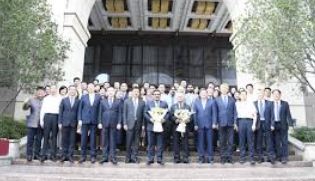
ISLAMABAD, SEP 14 (DNA) — Thousands of Pakistani students and professionals are set to benefit from a series of landmark agreements signed between Pakistan’s National Vocational and Technical Training Commission (NAVTTC) and leading Chinese institutions during Prime Minister Shehbaz Sharif’s recent visit to China.
NAVTTC has released complete details of the MoUs that were finalized at the second Pakistan–China B2B Investment Conference, aim to modernize Pakistan’s technical and vocational education and training (TVET) sector across multiple disciplines, Gwadar Pro reported on Saturday.
NAVTTC said the MoUs cover engineering, healthcare, agriculture, information technology, and digital skills, and will introduce Chinese curriculum standards, dual diploma programs, and digital education platforms in Pakistan. Training bases, joint colleges, and cultural exchange initiatives will create new opportunities for Pakistan’s youth to access global markets and employment.
Under the agreement with Gansu Vocational College of Nonferrous Metallurgy, Pakistan will host the “Bailie Workshop” Overseas Engineering Technology College, while a China–Pakistan International Education Digital Platform and overseas training base will support student mobility and academic collaboration.
Healthcare education will be strengthened through partnerships with Sichuan Vocational College of Health & Rehabilitation and Pingxiang Health Vocational College, including a “Chinese + Vocational Skills Training Base,” a new international college, and updated curricula in nursing and rehabilitation technology.
Guangzhou Polytechnic University will expand cooperation in software technology with Pakistan’s National University of Technology, while Wuhan Technical College of Communications will provide training for more than 30 Pakistani professionals and host international cultural exchange events.
Agriculture-focused agreements include Jiangxi Agricultural Engineering Vocational College, which will introduce programs in medicinal herb cultivation and herbal education, and Xinjiang Agricultural Vocational & Technical University, which will set up an Agriculture and Animal Husbandry Academy offering veterinary and animal husbandry training. Jiangxi Vocational College of Industry & Engineering will also establish the “BATIE Friendship Language Center” in Pakistan, teaching Chinese language, artificial intelligence, and new energy technology to 200–400 participants annually.
Yunnan Vocational Institute of Energy Technology will help establish the Pakistan Overseas Engineering & Technology University and train 50–100 Pakistani students in China each year, while Zhejiang Institute of Mechanical & Electrical Technicians will create an e-commerce live streaming academy and host the 2026 China E-Commerce Streamer Contest in Pakistan.
NAVTTC said the agreements mark one of the most comprehensive TVET cooperation packages between Pakistan and China, expected to benefit thousands of Pakistanis annually through training programs, academic exchanges, and digital education initiatives. — DNA
===========================
Pakistan’s exports to China grow in August despite overall decline
ISLAMABAD, SEP 14 (DNA) — Pakistan’s exports to China rose 2% in August to $158 million, even as the country’s overall shipments fell sharply and the trade deficit widened, provisional data from the Trade Development Authority of Pakistan (TDAP) showed.
In the first two months of the fiscal year (July–August), exports to China climbed 7% to $331 million, making it Pakistan’s third-largest buyer after the United States and the United Kingdom, according to Gwadar Pro on Sunday. Overall exports dropped 12.5% year-on-year to $2.42 billion in August, while imports rose 6.4% to $5.29 billion.
That pushed trade deficit to $2.87 billion, up 30% from a year earlier. For July–August, the deficit widened 29% to $6.01 billion. China also remained Pakistan’s top source of imports, with inbound shipments rising 33% to $2.99 billion in the first two months. Beijing thus remained both Pakistan’s biggest market for growth and its largest supplier of goods.
Despite the downturn, some categories bound for global and Chinese markets showed resilience. Textiles and leather, Pakistan’s mainstay sector, earned $3.39 billion during July–August, up 10% from last year. Bed linen, men’s apparel, cotton yarn and women’s garments led the way, while cement and dates also posted strong growth. Rice exports, however, fell by nearly a third.
Regionally, exports to Asia dropped 11% in the first two months, though China bucked the trend with steady growth. Economists say Beijing’s demand for Pakistani textiles, raw materials and food products is providing a crucial cushion as traditional markets in Europe and America record declines.
“China’s consistent demand has become a vital anchor for Pakistan’s exports,” economist Subhan Ahmad told Gwadar Pro. “As other markets slow, our trade with Beijing is helping sustain industrial activity and providing exporters with a reliable outlet.” — DNA