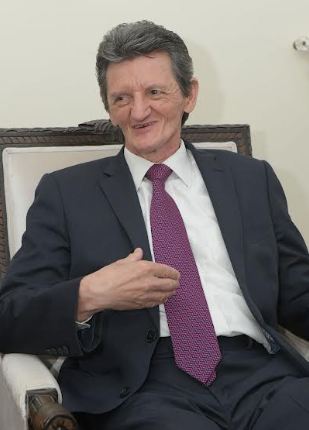
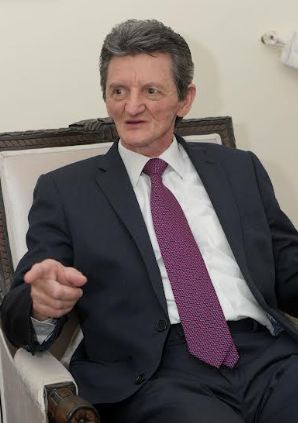
Ambassador of Hungary to Pakistan, Béla Fazekas, recently gave an exclusive interview to Centreline, Daily Islamabad POST, and the Diplomatic News Agency (DNA). He is currently serving his second term as Ambassador to Pakistan, which is set to conclude in June 2025. This marks his first interview in the past five years, and we are grateful to him for generously taking the time to speak with us. Below are the highlights of our conversation.
1: After serving two terms in Pakistan, how would you describe your overall experience?
As a two-time ambassador in Pakistan and having spent nearly a decade here, you not only witness the history of this country but to some extent you become also a part of it. And it is true vice versa as well. After so many years and experiences Pakistan became part of me leaving its mark on my personality. Those years made me more open and sensitive towards issues I did not attach enough attention before or took them for granted like climate resilience, the importance of empowerment of women, or the quality of mercy in Shakespearean sense.
2: How has your perception of Pakistan changed from the time you first arrived to now?
First of all, I myself changed a lot, but Pakistan also changed a lot from the time I first arrived in 2005 until now. As you can not step twice into the same river, you can not arrive twice to the same country. Pakistan has changed immensely. The most visible change is the rise of an affluent middle class and their share is growing continuously. A whole new service sector was built on this segment of the society. We know that the middle class is the backbone of democracy and an important source of economic growth, The other visible change is the emergence of a young generation which due to the social media is in close symbiosis with their peers wherever they live in the world. Despite these immense changes the general perception among foreigners about Pakistan unfortunately are still not too good. They are still influenced by old stereotypes. Stereotypes are similar to bad habits. They die hard. There is no doubt that stereotypes have some element of truth but the problem with them is that they still continue to influence even after the element of truth ceases to exist. I know that the reality had nothing to do with those perceptions. I remember Pakistan was considered in many foreign services a Non-family Duty Station. In some countries it still is. The first time I was here with my family with two small kids. And they enjoyed. Now as adults they come back to visit us, and they love this place. There are also other examples for changing perceptions. In 2023 Budapest hosted the World Athletic Championship. I was there in the stadium when Pakistan’s Arshad Nadeem won silver medal in javelin and only Neeraj Chopra from India could throw farther. One year later in the Paris Olympic Games Arshad Nadeem became Olympic champion. For many young people around the world his name is the first thing which comes to their mind when they hear the word Pakistan. This man made more for eliminating old stereotypes about Pakistan than anyone else. I was proud when we shook hands at a party.

3: What aspects of Pakistani culture, traditions, or hospitality stood out to you the most?
First of all as I can see there is a moral principle widely accepted among the members of the society to help the people in need. Unlike in some other countries of the Global South I never ever heard that people ever died of hunger in Pakistan. They might be malnutrated but not die. Maybe this moral principle is associated with the almsgiving which is a religious duty of all Muslims and one of the five pillars of Islam. Independently whether it is so or not, this moral principle makes the Pakistani people very respectful. As far as hospitality is concerned it is closely connected to the local tradition where guests are treated with respect and warm. I had many occasions to experience this feeling much more frequently than in any other countries where I served during my diplomatic career.
4: What key milestones have been achieved in Hungary-Pakistan relations during your tenure?
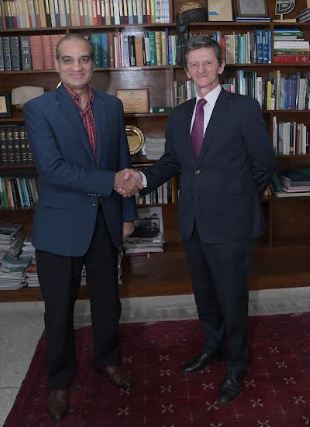
My fellow Ambassadors often ask me what was my greatest achievement during my two terms as Ambassador in this country. There might be a few, but one is certainly among them. This is the discovery that our relations with this part of the world are much older than our diplomatic relations. We celebrate the 60th anniversary of our diplomatic relations in 2025. My research in different archives led to the discovery of those longtime forgotten intellectual footprints what Hungarians- artists, professors, doctors, orientalists among them- left behind in the 19th and early 20th century while living and working in this part of the subcontinent. These footprints are engraved deeply into the memory of the Pakistani people forming a solid basis of our people-to-people relations. And-people-to- people relations are exactly what matter most. Governments can be changed, political regimes can be changed, but you cannot change people. The best way to foster people-to-people relations is soft power diplomacy. A few years back our Embassy has started a project to make the Pakistani public realize the extent of those Hungarian intellectual contributions without which Lahore for example would not have been so rich and vibrant place of the subcontinent as it was and still is. The project resonated very well with the present generation especially with the young people. Many of the current students of the University of Punjab have not even realized that their Alma Mater was founded by a Hungarian professor, even the second registar of the university was Hungarian. But I can also name some results in our government-to-government relations. I am proud of having lots of “first ever” events during my time as ambassador. I witnessed the first ever visit of a Hungarian Foreign minister to Pakistan, then later on the first ever visit of a Pakistani foreign minister to Hungary. By the end of my mission these interactions became so regular and numerous, that we can say “it is just business as usual”. But there were so many other “first evers” in all fields of our relations that it is really difficult to name all. I fostered the publication of the first ever Punjabi language collection of the poems of our national poet, Sándor Petőfi.
5: How do you assess the current state of political, economic, and cultural ties between Hungary and Pakistan?
The current state of the relations between our two countries are more than “friendly” and less than “strategic”. But we are less than a stone throw away from the latter. We have covered a long way until we have reached this state and the last five years were crucial in this regard. Economic and trade relations is a different issue. Here we have one of the biggest success story attributed to the Hungarian oil and gas giant, the MOL. MOL has been actively engaged in Pakistan’s oil and gas sector since 1999. Together with its local joint venture partners, it has contributed immensely to the energy security of Pakistan in the past 25 years. MOL and its partners have invested USD 3 billion in Pakistan to this day. Despite major security issues in its territory of operation (Khyber Pakhtunkhwa province), MOL continues to operate in Pakistan even as many other Western oil and gas companies have exited.
In sharp contrast to the MOL’s success story the state of our trade relations unfortunately is a far cry from our regular high level political contact. Although our bilateral trade turnover has doubled during the last five years from a very modest 50 million USD to a much better sounding 100 million this year, but it does not reflect the huge potential which still remained untapped. I understand that the golden days of the “Nokia period” of our trade during my first tenure when every second Pakistani has a Made in Hungary Nokia cellphone will not come back anymore, but we have to find a substitute product whatever that is.
6: How has Hungary contributed to Pakistan’s education sector, particularly through scholarships and student exchanges?
Hungary is not a big power. Neither politically, nor economically. But there is something, which gives us a soft power status, something we Hungarians are very proud of. We have one of the highest number of Nobel Prize winners per capita. This would have been impossible without a world class higher education system. Something we are ready to share with our Pakistani friends by offering state funded scholarships. The Hungarian government has opened the program for the young Pakistanis 10 years ago. First by offering 80 scholarships then raised the number to 200. In view of high demand our government has decided to double the number and now we provide 400 scholarships for Pakistan each year. But the demand is still huge. Every year there are 15 to 18 thousand applicants for 400 seats. Besides every year Hungarian universities receive hundreds of self-funding Pakistani students so at the end of the day it is not suprising that we have one of the largest Pakistani student diaspora in Europe, but definitely the largest one when it comes to the government sponsored scholarships.
7: How can Pakistan further strengthen its presence in Hungary, both economically and diplomatically?
It is for my Pakistani friends to decide. But as our relations are focused mainly on our economic and trade relations, you need to create at least the position of a commercial counselor at your Embassy if not a Pakistani trade office in Budapest. What also important is strengthening the people-to-people relations. You are very lucky having thousands of young, energetic, smart Pakistani students in Hungary. Each of them is the Ambassador of their country. You have to make better use of them. They can organize Pakistani cultural events, culinary demonstrations, they can introduce cricket to their Hungarian friends. These young people have the potential to establish Pakistan as a popular brand among young Hungarians. That is what we need.
8: Would you consider returning to Pakistan in a different capacity in the future?
Yes I would, but realistically speaking being closer to the 70 than to the 60, I do not think that Pakistan will be high on my bucket list. Otherwise, I would be happy to see those achievements which will turn this country into one of the success stories of the 21st century. No doubt, it will happen sooner or later.
9: If you were to describe Pakistan in one sentence, what would it be?
A young country with ancient civilization.
10: Do you have any farewell message for the people of Pakistan?
I just would like to thank to my Pakistani friends for treating me as someone from among them. I apologize if sometimes I was too honest, sometimes even too rude but it was never against them but for them.