DNA
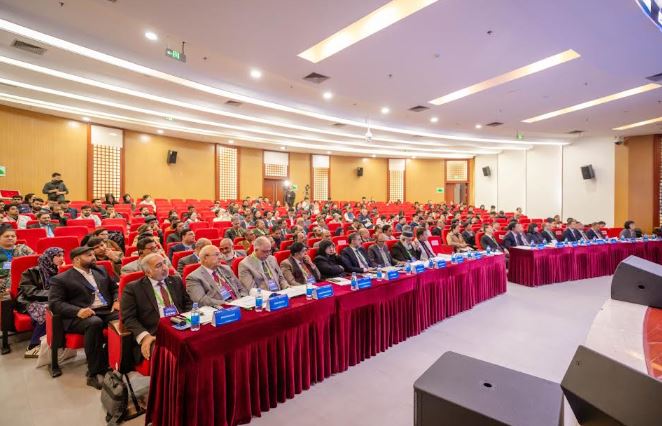
ISLAMABAD, OCT 16: The 6th Exchange Mechanism Conference of the China-Pakistan Economic Corridor (CPEC) Consortium of Universities was held at Harbin Engineering University, China.
Guided by the Higher Education Commission (HEC) Pakistan and the China Association of Higher Education, the conference titled, “Nurturing a Shared Future through Cooperation on High-Quality Development of Higher Education between China and Pakistan,” marked the 75th anniversary of diplomatic relations between the two countries. It brought together more than 120 representatives from over 40 universities and research institutions of Pakistan and China to strengthen bilateral cooperation in higher education, research and innovation.
Chairman HEC Dr. Niaz Ahmad Akhtar attended the opening ceremony alongside Zhang Daliang, Vice President of the China Association of Higher Education; Zhao Rongguo, Deputy Secretary-General of the People’s Government of Heilongjiang Province; Yin Jingwei, President of Harbin Engineering University; Gao Xiaojie, Deputy Secretary-General of the China Association of Higher Education; Zhao Yaqin, Deputy Director-General of the Education Department of Heilongjiang Province; Wang Yuanyuan, Vice President of Fudan University; and Yu Zhiwen, Vice President of Harbin Engineering University. Liu Yong, Deputy Director-General of the Department of International Cooperation and Exchanges of China’s Ministry of Education, and Syed Ali Asad Gilani, Ambassador of Pakistan to China, addressed the conference through video messages.
A key outcome of the conference was the release of the Annual Development Report on the Exchange Mechanism of CPEC Consortium of Universities. The report reviews progress since 2025 in developing cooperation networks, training human resources, conducting joint scientific research and promoting people-to-people exchanges. It also documents cooperation in key areas, including artificial intelligence, agriculture, mining, marine information and public health.
The conference also marked the inauguration of the High-Level Graduate Student Research Visit Programme for the CPEC in Pakistan, establishing a regular channel for Pakistani graduate students to undertake research visits and joint training in China. Harbin Engineering University signed cooperation agreements with Pakistani universities to strengthen sustained institutional partnerships. The list of newly inducted member universities of the Exchange Mechanism was also announced.
The Chinese and Pakistani secretariats presented their annual work reports, outlining the Exchange Mechanism’s operations and recent progress. Participants also reached consensus on bilateral collaboration priorities for the next phase.
During the university experience-sharing session, seven representatives from Chinese and Pakistani universities, including Harbin Engineering University, Peking University, Zhejiang University, The Hong Kong Polytechnic University, FAST-NUCES, Air University Islamabad and Bahria University, shared experiences and achievements in joint academic development, research collaboration and personnel training.
Four parallel forums were held on marine information, artificial intelligence and future development, advanced materials and intelligent manufacturing, and the China-Pakistan Youth Forum. Experts and scholars exchanged research findings and practical experiences and explored opportunities for deeper joint research, collaborative training and industry-academia-research cooperation.
Established in November 2017 through the joint initiative of the China Association of Higher Education and HEC Pakistan, the CPEC Consortium of Universities promotes cooperation between Pakistani and Chinese universities in human resource development, scientific research, technology application and people-to-people exchanges. Its member institutions align academic and research collaboration with CPEC-related priorities, including infrastructure development, energy and mineral resources, artificial intelligence, agriculture, environmental protection, and social and cultural exchanges.
Harbin Engineering University joined the Consortium in 2021. Drawing on its strengths in shipbuilding, ocean engineering and nuclear disciplines, the university has pursued cooperation in human resource development, faculty and student exchanges, and joint scientific research, contributing to bilateral academic and scientific collaboration and CPEC development.