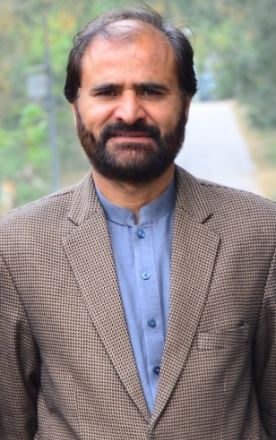
By Muhammad Rafi
The morning of October 8, 2005, remains etched in my memory. I was sitting in the library of Faisal Mosque, Islamabad, reading a newspaper when I suddenly felt the earth shake. As I hurried out of the library, I saw a man falling down the steps of Faisal Mosque. Almost the entire office staff had gathered outside. None of us could imagine that, in those few moments, countless families had lost their loved ones.
Soon, reports began arriving that a tower in Islamabad’s F-10 sector had collapsed and that the old courts building in Muzaffarabad had also been destroyed. Telephone contact with Muzaffarabad was cut off, leaving us desperate to know whether our relatives were safe.
That evening, Ali Bahadur called from Muzaffarabad and said that telephone service had been partially restored but the city had suffered massive destruction. Kamsar, where our extended family lived, was among the worst-affected areas. Roads leading from Muzaffarabad to Kamsar had been washed away in places, while landslides had blocked others. From Chehla Bandi to Kamsar, the landscape was filled with dust and devastation.
Then came the news that shattered me. My brother Muhammad Rafiq was critically injured, while my sister, Hafiza Naveeda, had died. Two children of my late uncle Abdul Qayum, Saddam and Rashida; Tair, son of my uncle Nasruddin; and Nazir and Iffat, children of my uncle Muhammad Mehboob, had also perished. According to locally received information, 296 people had died in Kamsar, with dozens more injured. Among the dead were my childhood friend Ishtiaq Butt, the mother of my grandmother’s friend Raja Shehzad Khan, the wife of Master Shabbir Lone and the wife of Muhammad Azim Lone.
Then I learned that my other sister, Shakeela, had also been trapped under the collapsed school building with other children and was seriously injured. The Kohala Road was blocked, and there seemed to be no way to reach Muzaffarabad.
At about 9 p.m., my colleague Muhammad Irfan called. After hearing about the situation, he said he planned to travel to Muzaffarabad via Abbottabad. I asked to accompany him, and he agreed. We had our pre-dawn meal in Haripur and continued towards Muzaffarabad in the morning. Balakot was devastated. Our vehicle was among the early vehicles to cross the Lohar Gali road. Near Muzaffarabad, we saw rubble everywhere, injured people, bodies and desperate calls for help. Many people were carrying injured relatives on their shoulders to safer places.
Beyond Gujrah, the road was blocked by debris, so we had to walk to Chehla Bandi. Despite the heat, exhaustion and fasting, we kept moving. There I met my younger brother Shahnawaz and other cousins. Shabbir Bhai, who had come from Kamsar, told me that Rafiq Bhai was seriously injured, our father was deeply distressed and medicines were urgently needed.
I returned to Gujrah, obtained the required medicines and also met BBC correspondent Zulfiqar at the University Ground, informing him about the situation. The courtyard of CMH Muzaffarabad was filled with bodies, while the university ground was crowded with injured people. Helicopters were transporting critically injured victims to hospitals, while Pakistan Army officers and soldiers were engaged in rescue and relief operations. At the Gujrah helipad, Major General Rashid Qureshi was supervising the relief operation.
By evening, I finally reached Kamsar. The entire area had been reduced to rubble. Raja Nisar Bhai was dressing the wounds of survivors on his own. In several places, three or four people had been buried together in mass graves, while some bodies were still trapped beneath the debris.
The scale of the tragedy became clearer with the official figures. The October 8 earthquake measured 7.6 on the Richter scale. According to Pakistani official records, 73,338 people were killed and 69,412 seriously injured, while around 3.3 million people were left homeless. Nearly 400,000 houses, hundreds of health facilities and around 6,000 schools and colleges were destroyed or badly damaged. Muzaffarabad, Bagh, Balakot, Mansehra, Battagram and many other areas were devastated.
The United Nations and many countries provided search-and-rescue teams, medical supplies, food, tents and other essential assistance. Turkey, China, Britain, France, Germany, Japan, South Korea and Russia were among those contributing to relief efforts, while the Red Cross and Red Crescent, OIC, NATO and numerous organizations played roles in relief and recovery.
Yet the brightest aspect of the tragedy was the spirit of brotherhood shown by the people of Pakistan. From every city and every section of society, people came forward to help their Kashmiri brothers and sisters. Some donated blood, others food, tents, vehicles or their savings. Young people, religious scholars, students, traders, journalists, political and social workers and ordinary citizens stood together for one purpose.
But this raises a painful question: Why could we not preserve that spirit of brotherhood?
Perhaps one major reason is that, with time, our collective sense of responsibility weakened while individual and group interests became stronger. In 2005, we faced a shared national tragedy. The earthquake temporarily erased many social and economic divisions. Every person felt that the suffering of an affected family was his or her own suffering. As normal life returned, however, that collective feeling gradually faded.
Political, social and regional divisions pulled us further apart. Personal, institutional and group interests increasingly overshadowed the national interest. We also forgot that crises do not belong to one class or one region. Inflation, unemployment, economic hardship and terrorism affect the whole society.
The lesson of 2005 is that a nation does not become strong merely by standing together during a disaster. True strength lies in making unity, sacrifice and empathy part of everyday life. We do not have to eliminate our differences; we must learn to rise above them whenever the national interest demands unity.
If the state, institutions, business community, youth and ordinary citizens once again support one another with the same sense of responsibility, we can confront economic hardship, fight terrorism and move towards national development.
October 8 taught us that earthquakes can shake the ground, but they cannot break the spirit of a united nation. The real question is: Are we ready to make that lesson part of our collective life once again?