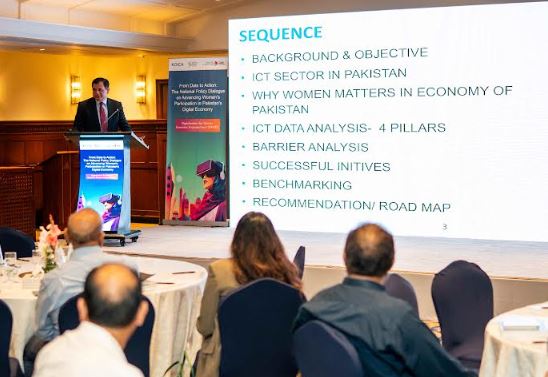
ISLAMABAD, AUG 18 /DNA/ – UN Women Pakistan, in partnership with the Pakistan Bureau of Statistics (PBS) and with the support of the Korea International Cooperation Agency (KOICA), hosted the National Policy Dialogue on Advancing Women’s Participation in Pakistan’s Digital Economy and launched Women in Information and Communication Technology (ICT) in Pakistan, a comprehensive national report mapping women’s participation in Pakistan’s digital economy.
The dialogue brought together stakeholders from government, the private sector, the mobile industry and development partners to discuss the report’s findings and identify practical pathways to advance women’s participation in Pakistan’s rapidly evolving ICT sector.
Speaking at the event, Ms. Fahmida Iqbal Khan, Deputy Country Representative, UN Women Pakistan, highlighted the importance of translating evidence into coordinated action. She said, “This report gives us a clear national picture of where women stand in Pakistan’s digital economy and where the gaps remain. The findings are a call to action for all of us. Data alone does not close gender gaps; it is what we do with it, together as government, industry, and development partners, that will determine whether Pakistan’s digital transformation truly includes women.”
Ms. Rabia Awan, Deputy Director General, Pakistan Bureau of Statistics, highlighted the importance of gender-disaggregated data. She said, “The report provides a comprehensive understanding of the landscape of women’s participation in Pakistan’s digital economy at the national level. It has strengthened our understanding of where our national data systems need to go to better capture women’s participation and identify existing data gaps. This evidence provides an important baseline for informed policy development. Reliable, gender-disaggregated statistics are the foundation of sound policymaking, and PBS remains committed to working to close these data gaps so that no woman is left uncounted in Pakistan’s digital progress.”
Produced under the Digitalization for Women Economic Empowerment (D4WEE) project, the report provides new, gender-disaggregated evidence across four key dimensions of the ICT ecosystem: education and digital skills, employment, entrepreneurship and leadership. The findings show that while Pakistan has made significant progress in improving women’s digital connectivity, substantial structural barriers continue to limit women’s participation in one of the country’s fastest-growing sectors.
Following the presentation of the findings, a multi-stakeholder panel discussion titled “From Data to Action: Advancing Women’s Participation in Pakistan’s ICT Sector” brought together representatives from the Pakistan Bureau of Statistics, Ministry of Information Technology and Telecommunication (MoITT), GSMA, and Pakistan Software Houses Association (P@SHA) to discuss how the report’s findings can be translated into concrete commitments across government, industry and the mobile sector.
UN Women Pakistan reaffirmed its commitment to supporting initiatives that advance women’s digital inclusion and economic empowerment in Pakistan, contributing to the achievement of the Sustainable Development Goals, particularly SDG 5 on Gender Equality and SDG 8 on Decent Work and Economic Growth.
About Women in Information and Communication Technology (ICT)in Pakistan Report:
The report puts forward recommendations across seven priority areas: digital infrastructure and connectivity, education and digital skills, employment, entrepreneurship, leadership, digital safety and governance. These recommendations are intended to guide coordinated action by government, the private sector and development partners in the years ahead.
The report finds that Pakistan has narrowed its mobile internet gender gap sharply, from 25 percent in 2024 to 8 percent in 2025. However, the country continues to have the widest mobile phone ownership gender gap among countries surveyed globally, with only 68 percent of women owning a mobile phone compared to 93 percent of men.
Women also remain significantly underrepresented in the labour market. Female labour force participation stands at 22.7 percent, compared to 68.7 percent for men, with women more likely to be concentrated in lower-value freelance work rather than higher-paying technical and technology-related roles.
Women’s participation in technology entrepreneurship also remains limited. Only 21 percent of startups supported by Ignite since 2018 are women-led, while just 5.7 percent of women are self-employed, compared to 29.6 percent of men.
The report further finds that as Pakistan’s digital economy shifts towards higher-value fields such as artificial intelligence, cybersecurity, cloud computing and data analytics, women risk being left further behind unless training, employment and hiring pathways are deliberately redesigned to ensure their inclusion.
The findings underscore that expanding access to technology alone is not sufficient to close the digital gender gap. Women need equitable opportunities to develop relevant skills, access decent work, build businesses, take on leadership roles and participate in shaping Pakistan’s digital future.