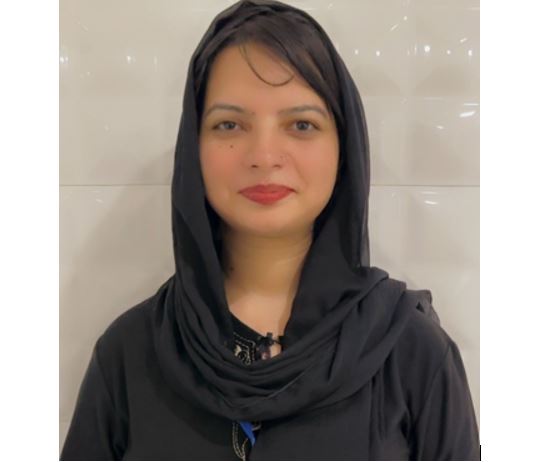
Amina Abdul Ghafoor
Recently, while sitting in a lounge with a group of professional women over tea, what began as a casual conversation took an unexpected turn. One of my friends quietly admitted that she deliberately avoids drinking water, tea, or coffee throughout the workday. We looked at her in surprise. “Why?” someone asked. She smiled awkwardly before replying, “Because there is no separate washroom for women at my workplace.” For a brief moment, the room fell silent.
Then, almost every woman around the table had a story of her own. One had worked in a factory where there was no dedicated ladies’ washroom. Another spoke about spending an entire shift without drinking water because she dreaded using a shared facility. Someone else recalled waiting until every male colleague had left before she could use the washroom in privacy. Others admitted they routinely held their bladder until they returned home because they did not feel comfortable or safe using the available facilities. What shocked us was not that these stories existed. It was that they were still being told in 2026. That conversation raised an important question. While Pakistan’s industrial sector has made remarkable strides in automation, robotics, and digital transformation, many workplaces still lack one of the most basic facilities required for an inclusive workforce. Factories equipped with world-class production lines and advanced machinery worth millions of rupees continue to overlook something so fundamental that it should never have remained an issue—a safe, private, and dedicated washroom for women.
Many workplaces still fail to provide something as basic as a safe, private, and dedicated washroom for women. Women working in Pakistan’s industries and corporates are not asking for special treatment. They are asking for one of the most basic workplace necessities. Until we provide that, our conversation about women’s empowerment remains incomplete. Pakistan is producing more women engineers, architects, scientists, and technical professionals than ever before. Universities continue to graduate thousands of talented women each year, eager to contribute to the country’s industrial and economic development. Government initiatives, universities, and private organizations all encourage greater female participation in STEM, engineering, manufacturing, and leadership. Yet one fundamental question remains largely unasked: Are our workplaces actually designed for women? According to the Asian Development Bank, women comprise only around 22% of Pakistan’s labour force, one of the lowest participation rates in South Asia. UNIDO estimates that women account for only 3.6% of employment in Pakistan’s major industrial sectors, while Gallup Pakistan reports that despite increasing numbers of women graduating in engineering, only around 28% enter employment.
We often attribute these numbers to cultural expectations, transportation challenges, family responsibilities, or social norms.
Those are certainly important factors. But perhaps we have overlooked another barrier, one that exists inside our workplaces.
If women hesitate to join or remain in corporate or industry because even the most basic facilities are missing, then perhaps the problem is not simply about attracting women into engineering.
Perhaps it is about making engineering workplaces ready for women. Unfortunately, the stories shared in that lounge are not isolated incidents. An investigation by the International Federation of Journalists (IFJ) documented remarkably similar experiences among women journalists in Pakistan. Women reported deliberately avoiding drinking water because there were no separate washrooms, waiting for male colleagues to leave before using shared facilities, and experiencing anxiety and health concerns due to inadequate sanitation. The issue clearly extends far beyond factories. It exists across offices, media organizations, construction sites, and numerous professional environments throughout Pakistan.
The World Health Organization (WHO) recognizes access to safe sanitation as a matter of health, dignity, equality, and fundamental human rights—not merely an infrastructure issue.
Research from Columbia University’s Mailman School of Public Health further reinforces this reality. The researchers conclude that adequate access to a private, comfortable, and well-located toilet remains a critical challenge for many girls and women around the world.
Their research explains that women have unique sanitation needs throughout different stages of life, particularly during menstruation, pregnancy, post-partum recovery, and certain medical conditions. At any given time, nearly one-quarter of adult women worldwide are menstruating and require private, hygienic facilities to manage their menstrual health with dignity. When these facilities are absent, women often avoid drinking water, delay using the toilet, and compromise both their health and productivity.
The research highlights another reality that strongly resonates within Pakistani society.
Unlike men, women often experience far greater expectations regarding modesty and privacy. Even entering or leaving a washroom, changing menstrual products, or disposing of sanitary waste can become a source of anxiety because these ordinary biological needs remain surrounded by social expectations and stigma. This anxiety is not created by women. It is created by the environments in which they are expected to work. Globally, the discussion has already evolved beyond simply providing separate washrooms.
Researchers now advocate for female-friendly washrooms—spaces equipped with menstrual hygiene facilities, sanitary waste disposal systems, secure locks, proper lighting, adequate water supply, accessibility for pregnant women and women with disabilities, and designs that protect women from harassment while ensuring dignity and comfort.
They argue that mainstreaming female-friendly toilets is essential for achieving the United Nations Sustainable Development Goals on health, sanitation, quality education, gender equality, and women’s economic empowerment. That is an important discussion. But for many women working in Pakistan’s industries, we have not yet reached that point. Before discussing advanced design standards, we must first achieve a far more fundamental milestone: Ensuring that every woman has access to a safe, secure, private, and dedicated washroom and a basic rest area at her workplace. Only then can we begin discussing how to make those facilities truly female-friendly.
Some employers argue that because there are only a handful of women in their organization, constructing a separate washroom is unnecessary. Perhaps we should ask the opposite question. How can we expect more women to join engineering, manufacturing, and industry if workplaces continue to be designed as though women were never expected to be there?
Facilities should not follow representation. Representation follows facilities. Pakistan has made remarkable progress in educating women. Now our industries must evolve at the same pace. The question is no longer whether women are ready for industry. The real question is whether our industries are ready for women.
A workplace may invest millions in their portfolio, marketing, products, manufacturing, robotics, automation, artificial intelligence, and digital transformation. Yet if a woman hesitates before drinking a glass of water because she fears using the washroom, that workplace has failed one of the simplest tests of inclusion. Genuine women’s empowerment is not measured by how many women are hired.It is measured by whether they can work with dignity once they are hired.And sometimes, dignity begins with something as simple as a clean, safe door marked “Ladies.”
The next time a corporate office, organization, commercial building, industrial facility, or factory opens its doors, let us not measure its success solely by its infrastructure, production capacity, automation, or technological advancement. Let us also ask a far more fundamental question:
Is it truly designed to welcome women with dignity, safety, and equal opportunity?
Amina Abdul Ghafoor
Manager Sales SCS- MSPM, BEE
Email: [email protected]