For Khan himself, insiders indicate that he may be advised to remain in the hospital for recovery and later at home, refraining from active politics until the next elections. Meanwhile, some of his party members could be integrated into the new political setup to maintain balance and continuity
Ansar M Bhatti
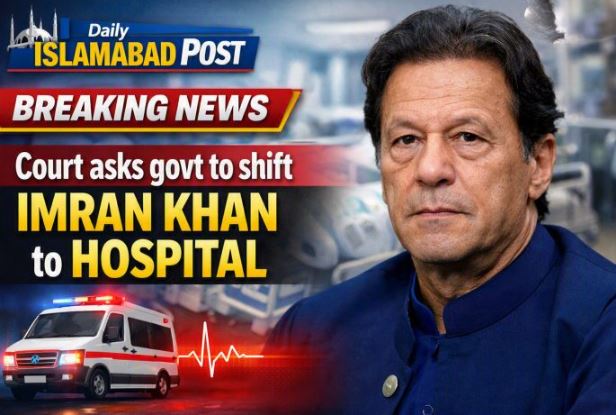
ISLAMABAD, AUG 18 /DNA/ – The Supreme Court has directed the government to transfer former Prime Minister Imran Khan from jail to Shifa International Hospital for medical treatment, following reports of deteriorating health and growing concerns over his well-being in custody.
The court issued the order after hearing a petition filed by Khan’s legal team, which argued that his health required urgent medical attention and that he should be treated in a proper medical facility rather than a prison cell. The bench emphasized that every citizen, regardless of status, is entitled to medical care under the law and instructed authorities to ensure his safety and dignity during the transfer.
Government representatives assured the court that arrangements would be made promptly, and a medical board would oversee Khan’s treatment. The court further directed that the board submit a detailed health report within a week to monitor his recovery and ensure transparency in the process.
Supporters of Imran Khan welcomed the court’s decision, calling it a step toward justice and humane treatment. Political observers, however, believe the ruling carries deeper implications for Pakistan’s political landscape. The Daily Islamabad Post has consistently maintained that until Imran Khan is granted relief, political stability in the country will remain elusive.
Now, as the current government completes its third year—a period often considered the natural political lifespan of administrations in Pakistan—new alliances are expected to emerge. Sources suggest that relations between the Pakistan Peoples Party (PPP) and the establishment have grown tense, prompting speculation that the establishment may seek new political alignments. A possible scenario could involve a coalition between Pakistan Muslim League-Nawaz (PML-N) and a restructured Pakistan Tehreek-e-Insaf (PTI) minus Imran Khan.
For Khan himself, insiders indicate that he may be advised to remain in the hospital for recovery and later at home, refraining from active politics until the next elections. Meanwhile, some of his party members could be integrated into the new political setup to maintain balance and continuity.
In this context, the Supreme Court’s decision can be viewed not only as a humanitarian gesture but also as a move with potential political undertones. It may pave the way for a transitional phase in which Pakistan’s political forces realign ahead of the next electoral cycle.
As the government prepares to implement the court’s directive, all eyes remain on how swiftly and transparently the transfer will be carried out and what it might signal for the country’s evolving political equation.