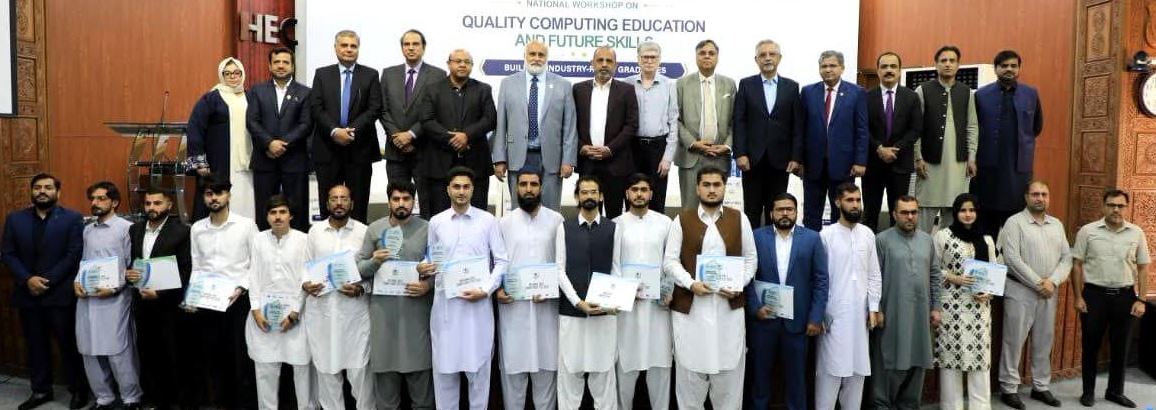
ISLAMABAD, JUL 22 /DNA/ – The Higher Education Commission (HEC), Pakistan, organized the National Workshop on Quality Computing Education and Future Skills at HEC Secretariat, Islamabad.
The workshop brought together distinguished policymakers, vice chancellors, academics, industry leaders, representatives of accreditation bodies, technology experts, and students to deliberate on enhancing the quality of computing education and equipping graduates with future-ready competencies aligned with national development priorities and the evolving demands of the global digital economy.
Addressing the participants, Dr. Niaz Ahmad Akhtar, Chairman, HEC, underscored that the future of Pakistan’s digital economy depends on the provision of quality computing education.
Referring to the Prime Minister’s vision for digital transformation, he highlighted HEC’s key initiatives aimed at strengthening computing education, including the implementation of the Computing Curriculum 2025, integration of Artificial Intelligence (AI) into academic programmes, promotion of Outcome-Based Education (OBE), and implementation of the National Skills Competency Test (NSCT) to enhance graduates’ competencies, industry readiness, and employability.
Delivering the welcome remarks, Prof. Dr. Habib Bokhari, Member (Research, Development & Innovation), HEC, stated that the workshop was organized to raise awareness among students, parents, academia, and industry about the importance of quality computing education, emerging technologies, future-ready skills, and evolving career opportunities.
He reaffirmed HEC’s steadfast commitment to modernizing computing curricula, strengthening academia-industry collaboration, enhancing quality assurance mechanisms, and equipping graduates with the knowledge and competencies required to meet the demands of a rapidly evolving digital economy.
The event was graced by Mr. Hassan Saqlain, Additional Secretary, Ministry of Federal Education and Professional Training, as the Chief Guest. Senior officials from the Ministry of Information Technology & Telecommunication (MoITT), Pakistan Software Export Board (PSEB), Pakistan Software Houses Association (P@SHA), National Computing Education Accreditation Council (NCEAC), Virtual University of Pakistan, vice chancellors from universities, IT students from various higher education institutions, and representatives of HEC participated in the workshop.
The workshop featured an interactive panel discussion moderated by Mr. Hidayatullah Kasi, Deputy Director (Curriculum), HEC.
The panel comprised representatives from PSEB, P@SHA, NCEAC, members of the National Curriculum Review Committee (NCRC) for Computing, and HEC.
The discussion focused on the skills demanded by the IT industry and the future workforce, aligning computing curricula with emerging technologies and evolving market needs, strengthening accreditation systems and quality assurance mechanisms, promoting faculty development, industry immersion, and collaborative research, and expanding industry-led internships, capstone projects, professional certifications, and other initiatives to enhance graduate employability.
Representatives from academia and industry also shared valuable insights on bridging the gap between higher education and market requirements, particularly in the fields of artificial intelligence, cybersecurity, cloud computing, software engineering, data science, and digital innovation.
They highlighted the need for continuous curriculum review, faculty capacity building, experiential learning, and stronger collaboration with the technology industry.
At the conclusion of the event, shields of appreciation were presented to the Chief Guest, moderator, panelists, and other distinguished contributors in recognition of their valuable support and contributions to the success of the workshop.
In addition, the top 17 achievers of the National Skills Competency Test (NSCT) 2026 were honored with shields and certificates of appreciation in recognition of their outstanding performance.
The awards acknowledged their academic excellence and encouraged merit, innovation, and excellence in computing education.=DNA