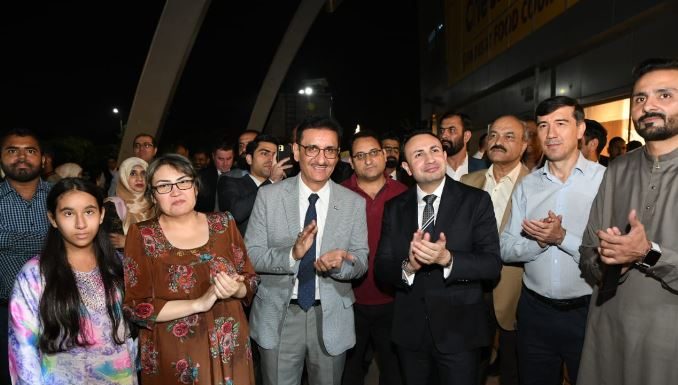
ISLAMABAD, JUL 1 /DNA/ – Federal Minister for Finance and Revenue, Senator Muhammad Aurangzeb, on Wednesday commended the Federal Board of Revenue (FBR) for successfully achieving the revised annual revenue collection target for FY2025-26, describing it as a landmark accomplishment made possible through teamwork, sustained reforms, and the unwavering commitment of the entire FBR leadership and field formations.
Addressing a meeting at FBR Headquarters attended virtually by Chairman FBR Rashid Mahmood Langrial, Members of the FBR Board, senior officers, and Chief Commissioners and Chief Collectors joining virtually from across the country, the Finance Minister conveyed the congratulations of the Prime Minister to the entire FBR team for its dedication and hard work throughout the fiscal year.
The Finance Minister said the achievement should be viewed in the context of Pakistan’s broader reform journey over the past two and a half years, during which the country’s revenue collection had nearly doubled. He observed that this remarkable progress represented one of the most significant improvements in Pakistan’s fiscal history and had played a pivotal role in strengthening the country’s macroeconomic fundamentals. He noted that alongside improved external sector indicators, Pakistan had recorded its lowest fiscal deficit and highest-ever primary surplus, achievements made possible through strong revenue performance coupled with prudent fiscal management.
Senator Aurangzeb particularly appreciated the efforts of the Inland Revenue and Customs formations, noting that the FBR had delivered strong revenue growth despite providing substantial tariff relief to facilitate economic activity. He also lauded the Board for processing and disbursing Rs. 599 billion in tax refunds during the year, including an unprecedented Rs. 13.5 billion released on the last day of the fiscal year, describing it as a significant milestone reflecting the government’s commitment to facilitating businesses and exporters.
The Finance Minister congratulated both the Finance Division and FBR on the successful coordination during the preparation of the Federal Budget 2025-26, describing the seamless integration of tax policy and tax administration as an excellent example of teamwork. He said the collaborative approach had resulted in one of the most progressive budgets in Pakistan’s history and reflected the government’s institutional commitment to reform.
Highlighting the government’s forward-looking reform agenda, Senator Muhammad Aurangzeb emphasized that modern tax administration must focus not only on revenue collection but equally on taxpayer facilitation, transparency, and public trust. He stressed the need to make tax compliance easier through technology-driven solutions, greater automation, improved taxpayer services, and reduced opportunities for discretion and corruption.
The Finance Minister said the government’s newly approved operating model for FBR would accelerate institutional transformation through reforms centred on people, processes, and technology, including the expanded use of artificial intelligence and digital systems. He expressed gratitude to Parliament for supporting the legislative framework required to implement these reforms and reaffirmed that the government remained fully committed to transforming FBR into one of Pakistan’s leading public institutions. He also acknowledged the personal leadership, guidance, and continuous oversight of the Prime Minister in driving the country’s tax reform agenda.
Addressing the meeting, Chairman FBR Rashid Mahmood Langrial thanked the Finance Minister for visiting FBR Headquarters on the first day of the new fiscal year and for his continued support of the institution. He appreciated the close coordination between the Finance Division and FBR throughout the budget process, particularly during consultations with the IMF, provincial governments, coalition partners, parliamentary committees, and other stakeholders.
The Chairman highlighted the professionalism displayed by officers from both the Finance Division and FBR, stating that their technical competence and collaborative approach had enabled the government to successfully navigate complex fiscal and tax policy challenges. He noted that the reform process had demonstrated the strength and capability of Pakistan’s civil service when working collectively towards national objectives.
Chairman Langrial also underscored the importance of institutional reforms within FBR, particularly efforts aimed at promoting merit, professionalism, and integrity across the organization. He said recent appointments of high-integrity officers to key field positions had demonstrated that effective revenue administration could be achieved while maintaining the highest standards of transparency and professionalism.
The Chairman further briefed the meeting on the ongoing modernization initiatives within FBR, including major technology upgrades, enhanced customs systems, artificial intelligence-based solutions, and extensive capacity-building programmes. He reaffirmed the Board’s commitment to implementing the government’s reform agenda and expressed confidence that these initiatives would further improve taxpayer services, strengthen compliance, and modernize Pakistan’s tax administration.
The meeting concluded with the Finance Minister once again congratulating the entire FBR team for its outstanding performance and expressing confidence that, through continued teamwork and effective implementation of reforms, the institution would continue to make a significant contribution towards Pakistan’s economic stability and sustainable growth. He invited the participants to give a standing round of applause in recognition of Chairman FBR Rashid Mahmood Langrial and the collective efforts of the entire FBR team.