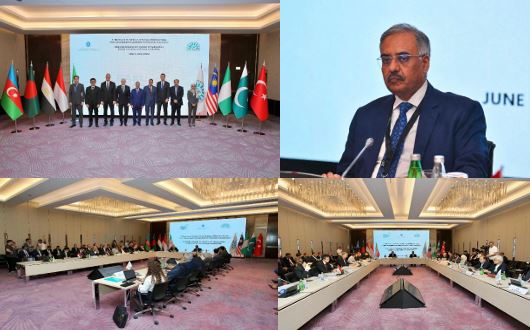
BAKU, JUN 3 /DNA/ – The Developing-8 Organization for Economic Cooperation (D-8) marked a significant milestone with the successful convening of the First Meeting of the Ministers of Energy of D-8 Member States in Baku, Republic of Azerbaijan, on 1 June 2026.
Hosted by the Ministry of Energy of Azerbaijan on the sidelines of Baku Energy Week, the Ministerial Meeting brought together Ministers and senior representatives from D-8 Member Countries under the theme “Enhancing Cooperation in Sectors of Hydrocarbon, Energy Transition and Energy Connectivity.”
Chaired by H.E. Parviz Shahbazov, Minister of Energy of Azerbaijan, the Meeting was attended by highlevel delegations from Azerbaijan, Bangladesh, Egypt, Indonesia, Iran, Pakistan, Türkiye and Malaysia, as well as H.E. Ambassador Sohail Mahmood, Secretary-General of the D-8 Organization along with his delegation.
In his opening remarks, Minister Shahbazov underscored the growing importance of enhanced cooperation among D-8 Member States amid evolving global energy dynamics, emphasizing the need to strengthen collaboration in hydrocarbons, energy transition, and energy connectivity. He highlighted Azerbaijan’s commitment to promoting regional energy security, sustainable development and diversified energy partnerships across the D-8 region.
Addressing the Meeting, Secretary-General Ambassador Sohail Mahmood described the first-ever meeting of the D-8 Energy Ministers as a landmark step in implementing the Decennial Roadmap (2020-2030), which identifies energy as a key pillar of D-8 cooperation. He stressed that energy serves as a strategic driver of economic growth, industrial development, trade competitiveness, technological advancement and sustainable prosperity across the Member States. He also emphasized the need for a balanced and pragmatic approach that recognizes the continued role of hydrocarbons in ensuring energy security, affordability and reliability, while simultaneously accelerating investments in renewable energy and low-carbon solutions.
Going forward, the Secretary-General outlined five priority areas for practical cooperation: the development of a D-8 Energy Cooperation Framework and Action Plan with clear targets and timelines; establishment of an energy investment facilitation mechanism to mobilize public and private capital; strengthened collaboration on innovation and emerging technologies, including renewables, hydrogen, storage and smart grids; enhanced capacity-building and technical cooperation through training and institutional partnerships; and expanded energy connectivity and cross-border infrastructure cooperation, where feasible and mutually-beneficial. D-8 Organization for Economic Cooperation
The principal outcome of the Ministerial Meeting was the adoption of the “Baku Declaration on Energy Cooperation,” which establishes a comprehensive framework for practical, result-oriented and forward looking cooperation in the energy sector.
The Declaration reaffirms the pivotal role of energy cooperation in promoting energy security, economic diversification, industrial development, and sustainable resilience across D-8 Member States. It also underscores the importance of maintaining stability and predictability in energy markets through strengthened cooperation and energy diplomacy.
Under the Declaration, Member States agreed to enhance cooperation in the following priority areas:
• Clean and renewable energy development;
• Energy connectivity and cross-border energy infrastructure;
• Cooperation across the hydrocarbon value chain;
• Investment facilitation and private-sector engagement;
• Technology, innovation and capacity-building;
• Strengthened institutional coordination and implementation mechanisms; and
• Collaboration between the energy and mining sectors.
Another key highlight of the Meeting was the presentation of the proposed Charter of the D-8 Energy and
Climate Center (D-8 ECC) being established by Azerbaijan in Baku. The Ministers commended
Azerbaijan’s initiative and recognized the Center’s potential to serve as a flagship D-8 institution for
promoting technical cooperation, project development, investment facilitation, knowledge-sharing and capacity-building in the fields of energy and climate.
The participants also supported the establishment of a D-8 Energy Senior Officials Group (SOG) to ensure effective follow-up and implementation of Ministerial decisions and to strengthen institutional coordination among Member States.
The Meeting further underscored the strategic geographical position of D-8 Member States as a bridge between major energy-producing regions, international transit corridors and global consumer markets.
Participants emphasized the importance of pursuing balanced, realistic and nationally driven pathways toward energy transition while ensuring energy security, affordability, accessibility and sustainability.
The successful convening of the First Meeting of D-8 Energy Ministers and adoption of the Baku Declaration form a solid foundation for structured and long-term energy cooperation within the D-8 framework. The outcomes reflect the collective commitment of Member States to advancing a practical, inclusive and sustainable energy agenda for the benefit of their economies and peoples.
D-8 Organization for Economic Cooperation
The D-8 Secretariat looks forward to working closely with Member States, partners, and relevant stakeholders to implement the decisions contained in the Baku Declaration and further strengthen energy cooperation as one of the central pillars of D-8 collaboration.