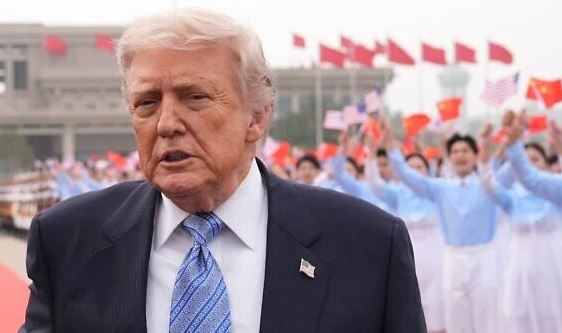
WASHINGTON, MAY 15: US President Donald Trump said Friday that he would accept a 20-year suspension of Iran’s nuclear program if Tehran gave a “real” commitment, apparently walking back his previous demands that Iran permanently halt its program.
Asked by a reporter on Air Force One as he departed China following his two-day summit with President Xi Jinping whether a 20-year suspension would be sufficient, Trump responded, “Twenty years is enough, but the level of guarantee from them, it’s got to be a real 20 years.”
In the past, Trump has demanded that Iran agree to forever cease enrichment, and commit to never seeking nuclear weapons, claiming that he didn’t want to pass the problem off to a future president.
While Trump gave no further details on what the suspension would entail, the 20-year commitment appears to mirror the much-maligned “sunset clause” in the 2015 nuclear deal with Iran that would have allowed Tehran to enrich unlimited amounts of uranium once the deal elapsed.
Trump had pulled the US out of that agreement, calling the sunset clause “totally unacceptable” and saying that it would spark a nuclear arms race in the Middle East.
However, Trump on Friday also said his patience with Iran was running out and that he had agreed in talks with Xi that Tehran could not be allowed to have a nuclear weapon and must reopen the Strait of Hormuz.
Tehran denies seeking nuclear weapons, but it has enriched uranium to levels that have no peaceful application, obstructed international inspectors from checking its nuclear facilities, and expanded its ballistic missile capabilities.
Washington and Tehran announced a ceasefire last month but have been struggling to thrash out a lasting peace pact. Talks mediated by Pakistan have been suspended since Iran and the US each rejected the other’s latest proposals last week.
Israel, which launched the military campaign against Iran jointly with the US six weeks ago, is not represented at the talks. Host Pakistan has no diplomatic ties with Israel and does not recognize its sovereignty.
The ceasefire declared by Trump in April came with core declared goals of the war unfulfilled, including ensuring that Iran does not attain nuclear weapons, destroying its missile program, and creating the conditions for the Iranian public to overthrow the regime.
Speaking to reporters on Air Force One, Trump also said he discussed lifting sanctions on Chinese companies that buy Iranian oil during his visit to Beijing and will make a decision soon.
Advertisement
The US recently imposed sanctions on several Chinese oil refiners for buying Iranian oil, including Hengli Petrochemical 600346.SS, one of the country’s largest private refiners and a symbol of Beijing’s drive to modernize and upgrade the industry.
“We talked about that and I’m going to make a decision over the next few days,” Trump said.
US officials, including Trump, raised the possibility of China buying more American energy over the course of the summit, although Chinese readouts of the meeting made no mention of any deals.
‘No trust’
While Trump indicated there was flexibility in the US position, Iranian Foreign Minister Abbas Araghchi said on Friday that Tehran has “no trust” in the US and would only be interested in negotiating with Washington if it was serious.
Araghchi told reporters in New Delhi that “contradictory messages” had raised Iranian doubts about the Americans’ real intentions, adding that the Pakistani mediation process had not failed but was in “difficulty.”
Iran is trying to keep the latest ceasefire to give diplomacy a chance, but is also prepared to go back to fighting, Araghchi said.
“What was said that the United States rejected Iran’s proposal or Iran’s response to the American proposal was a few days ago, when Mr. Trump tweeted and said that it was unacceptable,” Araghchi said.
“But after that, we received messages again from the Americans saying that they are willing to continue the talks and continue the interaction.”
Advertisement
The issues holding up negotiations between the two sides include Iran’s nuclear ambitions and its control of the Strait of Hormuz.
With regard to Hormuz, Araghchi claimed all vessels can pass through the Strait of Hormuz except those “at war” with Tehran, if they coordinate with Iran’s navy.
But the situation around the waterway, vital to global energy and commodities markets, was “very complicated,” he added, during a visit to attend a BRICS foreign ministers’ meeting in India.
Iran effectively shut the strait, which normally handles about one-fifth of the world’s seaborne oil and gas supply, to most shipping after the US and Israel began their war on Iran in February.
On Thursday, a ship anchored off the east coast of the United Arab Emirates was seized and was heading toward Iranian waters, the British military said, while India said a cargo ship was sunk amid the battle over the strait.
Asked if Tehran was open to mediation by Beijing, Araghchi said Friday Iran appreciated the efforts of any country that had the ability to help.
“We have very good relations with China,” he said. “We are strategic partners, and we know that the Chinese have good intentions. So, anything they can do to help diplomacy would be welcomed.”
Araghchi added: “We hope that, with the advancement of negotiations, we will reach a good conclusion so that the Strait of Hormuz can be completely secured and we can expedite the normalisation of traffic through the strait.”
BRICS ministers fail to issue joint statement over Mideast conflict
The two-day BRICS meeting concluded without a joint statement because of “differing views among some members” on the situation in the Middle East, host India said.
Advertisement
The differences highlighted the challenge of maintaining unity within the bloc as it seeks to expand its influence.
Russia’s Foreign Minister Sergey Lavrov, third right, talks to Vice Minister of Foreign Affairs of Saudi Arabia, Waleed bin Abdulkarim, second right, as Indian Foreign Minister S.Jaishankar, right, South Africa’s Minister of Foreign Affairs Ronald Lamola, second left, Iranian Foreign Minister Abbas Araghchi, left, and and Vietnam Deputy Foreign Minister Nguyen Hang, third left, watch at a photo call of Government representatives and partner countries of BRICS during a two day meeting in New Delhi, India, May 14, 2026. (AP Photo/Manish Swarup)
The Indian statement said members expressed “their respective national positions and shared a range of perspectives” on issues including sovereignty, maritime security, and the protection of civilian infrastructure and civilian lives in the Middle East.
It also included a footnote saying that “a member had reservations” about parts of sections dealing with Gaza and security in the Red Sea and Bab al-Mandeb Strait.
BRICS includes Brazil, Russia, India, China, South Africa, Ethiopia, Egypt, Iran, the United Arab Emirates and Indonesia.
Divisions among members have become more visible during the Iran war, particularly between Iran and the UAE — which Iran repeatedly attacked with missiles and drones throughout the war.
Araghchi on Thursday urged BRICS nations to condemn the US and Israel over what he described as their “unlawful aggression.” He also called on member states to resist what he said was the politicization of international institutions.