UNITED NATIONS, Apr 17: Pakistan highlighted its role aimed at ending the US-Israeli war on Iran and mediating a durable peace as the UN General Assembly Thursday heard explanations from China and Russia regarding their use of the veto on April 7, rejecting a Gulf States-led resolution in the Security Council that called for re-opening the Strait of Hormuz.
Pakistan had abstained on the draft in the 15-member Council, along with Columbia, on the Bahrain-drafted resolution, which received 11 votes in favour, with Russia and China voting against.
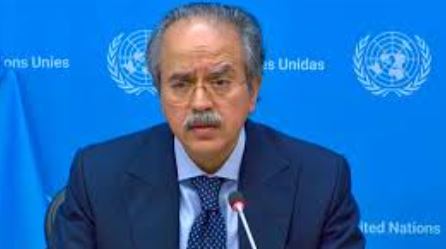
“The Strait of Hormuz is an important international shipping route for goods and energy,” Ambassador Asim Iftikhar Ahmad, permanent representative of Pakistan to the UN, told the 193-member Assembly, underscoring the need for safe passage of civilian ship as the situation in the Strait was adversely impacting countries around the world.
It may be pointed out that the General Assembly cannot overturn or nullify a Council veto, which may be exercised by China, France, Russia, United Kingdom or the United States as the five permanent Council members.
But, it may discuss, scrutinize and politically respond to veto use through debate and resolutions under the UN Charter and established practice.
This role was significantly strengthened in April 2022, when the Assembly adopted a procedure requiring every Council veto to trigger an Assembly debate within 10 working days.
Today’s debate was held under this initiative, which requires vetoing States to explain their rationale and allows all UN members to comment on and assess the veto’s consequences, thereby enhancing transparency and accountability.
In his remarks, Ambassador Asim Ahmad said Pakistan supports the sovereignty, territorial integrity, political independence and security of “all brotherly countries” in the region, while any discussion or arrangement related to the Strait must consider the legitimate interests of the Gulf Cooperation Council (GCC) countries.
In Pakistan, Ambassador Asim Ahmad said the impact of the conflict is felt not only in terms of energy supplies, but also in fertilizers and other essential commodities, “squeezing the livelihood of the most vulnerable”.
If disruptions persist, suffering will become widespread, the Pakistani envoy said. “Return to peace will benefit all,” he said, agreeing on the objective of opening the strait and normalization of the situation “at the earliest” opportunity.
In this regard, Ambassador Asim Ahmad said the “successful” Islamabad talks on 11 and 12 April were made possible by Pakistan’s engagement and outreach to promote an immediate end to the strikes and counter strikes.
“Through the Islamabad process, Pakistan is pursuing the objective of ending the war and ensuring long-term peace,” the Pakistani envoy said.
Under the terms of the April 7 vetoed draft resolution, the 15-member Council would have demanded that Iran immediately cease all attacks against merchant and commercial vessels and any attempt to impede transit passage or freedom of navigation in the Strait of Hormuz.
Russia’s Ambassador Anna Evstigneeva said her country had used the veto because the resolution ignored the broader context of the conflict and would have given the Council “a green light” to use certain protective measures “under the pretext” of ensuring the safety of navigation.
She condemned the US-Israeli aggression against Iran, which contravenes the UN Charter and international law. Some Council members had turned “a blind eye” to the root causes of the escalation, the Russian envoy said.
“Every paragraph was replete with confrontational and factually incorrect elements,” she added, warning against “enshrining the possibility of using force on the basis of vague criteria” and “the attempt to paint Iran as the sole threat to international peace and security”.
“China approaches every vote in the Council with a serious, conscientious and responsible attitude”, said Ambassador Fu Cong, noting that his country, along with Russia, voted against the draft.
China’s veto, Ambassador FU Cong said, upheld international fairness and justice, defended the UN Charter, prevented further escalation and created favourable conditions for dialogue.
Beijing “always determines its voting position based on the merits of the issue itself and whether the adoption of a resolution would genuinely contribute to resolving the issue and achieving peace”, he said.
Council action must aim to de-escalate — not “provide a veneer of legitimacy for unauthorized military operations or grant a license to the use of force”.
Iran’s Ambassador Amir Saeid Iravani of Iran told the General Assembly the vetoes cast by China and Russia last month in the Security Council were “timely, justified and necessary”.
The text was one-sided and ignored the root causes of the crisis – an illegal and savage war of aggression waged by the United States and Israel.
Its adoption would have set a dangerous precedent, he said, adding that Iran is a responsible State committed to the UN Charter and has consistently fulfilled its responsibility as the custodial State of the Strait of Hormuz.
He called the US blockade a grave violation of Iran’s sovereignty and territorial integrity, constituting “a clear act of aggression on international law”.
In the days since these vetoes were cast, critical shipments have been delayed, fertilizers have failed to reach countries in Africa and South Asia, and vulnerable populations have faced food insecurity.
The Strait of Hormuz — like all straits — is “too vital to be choked, to be mined, to be weaponized and held hostage by the likes of the Iranian regime”, he warned.