by Muhammad Mohsin Iqbal
There are moments when imagination becomes an act of devotion, when the heart travels across centuries and finds itself resting upon the sacred soil of Madinah. In such moments I do not see myself as a traveler, a scholar, or a writer. I imagine myself as something far humbler—an unnoticed particle of dust lying quietly upon the blessed path where the beloved Messenger of Allah, Prophet Muhammad (Peace and blessings of Allah be upon him), once walked.
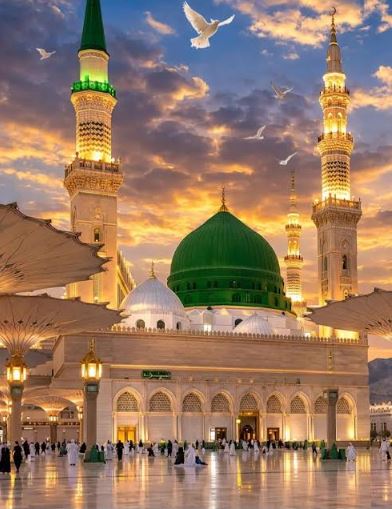
If I were that dust, I would not possess a voice, yet my silence would carry a story greater than words. My existence would be small and weightless, yet my fortune would be immeasurable. For what greater honour could there be than to rest upon the road of Madinah and wait with trembling anticipation for the moment when the footsteps of the Messenger pass over me?
Every morning in Madinah would be a dawn of longing. I would lie quietly upon the earth, feeling the gentle wind move across the streets. Around me the city would awaken—its people preparing for prayer, its hearts beating with love for the one whose presence had transformed a desert town into the centre of light. But my gaze, if dust could possess such a gaze, would remain fixed upon one hope; that the blessed feet of the Messenger would pass along this path.
Then, at last, the moment would arrive. The beloved Prophet (Peace be upon him) would emerge with the grace that history struggles to describe. His presence would carry both majesty and humility, light and tenderness. When his blessed foot would touch the ground, I myself, an insignificant grain of dust—would feel a joy that the heavens themselves might envy. I would cling to the sole of his sandal, trembling with gratitude, whispering silently to myself; “O my Almighty Allah, among all the particles of this vast earth, You chose me for this honour.”
If dust could weep, I would weep in that moment.
This is the emotion that resonates in the verses of the great lovers of the Prophet (Peace be upon him), much like the Sufi saint and poet Pir Mehr Ali Shah conveyed in a Punjabi poem that moves every devotee to tears. Similarly, Qudratullah Shahab, the renowned bureaucrat and devoted admirer of the Holy Prophet, upon arriving in Madina, humbly poured the dust of its streets into his eyes as an act of deep devotion.
How fortunate that dust would be which the wind might lift gently and place upon the blessed garment of the Prophet (Peace be upon him). How lucky that dust which might remain beneath his feet as he walked to the mosque, to the homes of the poor, or through the streets where children gathered with smiles.
Sometimes I imagine that the breeze of Madinah would carry me from the road to the threshold of the Prophet’s mosque. There I would rest quietly while the Companions gathered around him with love and reverence. Their hearts would overflow with devotion as they listened to his words—words that transformed hearts of stone into hearts of mercy.
At times the Prophet would smile, and that smile would illuminate the gathering like moonlight. Embody the beauty that Jami described in his poems. At times he would speak with gentleness, guiding humanity away from darkness toward light. And I, a tiny particle of dust upon the ground, would listen in silent gratitude, knowing that even angels in the heavens longed for the blessings that filled that gathering.
The lovers of the Prophet in every age have tried to capture this feeling. In the heartfelt recitations of naats that echo through gatherings today, including those rendered with deep emotion by Abrar-ul-Haq, one hears the same longing; the longing to belong to the Prophet, to be near him, to be counted among those fortunate souls who walked in his presence.
Yet the greatest pride of that dust would not merely be touching his footsteps. It would be witnessing the humility and compassion that flowed from his noble character. The Messenger of Allah did not walk the earth like a king surrounded by pride. He walked like a servant of Allah, greeting the poor, comforting the weak, and forgiving those who wronged him. Even the dust beneath his feet would feel that mercy.
And when the sacred night of Isra and Mi’raj arrived, I imagine myself resting quietly in Madinah while the heavens prepared for a moment unlike any other in history. That night the beloved Messenger was invited beyond the realms of earth, ascending through the heavens in a journey granted to no other human being. The angels welcomed him, the prophets greeted him, and he was honoured with a nearness to the Divine presence that words cannot fully describe.
Yet after witnessing the splendour of the heavens, he returned again to the earth—to guide humanity, to pray for his Ummah, and to continue walking upon the humble soil of Madinah. And perhaps, by the mercy of Allah, he would once again walk upon the very dust that I imagined myself to be.
If I were that dust, I would not wish to rise higher than his footsteps. My pride would lie in remaining beneath them forever. For to be dust in Madinah beneath the feet of the beloved Prophet (Peace be upon him) would be a station greater than any throne of the world.
Such is the strange mystery of love: that the lover does not seek elevation but humility. The lover seeks not to rise above others but to fall into the dust of devotion. And if Allah were to grant even a fragment of that honour, then a particle of dust would become richer than kings—because it had once rested beneath the footsteps of Muhammad, the beloved Messenger of Allah (peace and blessings be upon him).