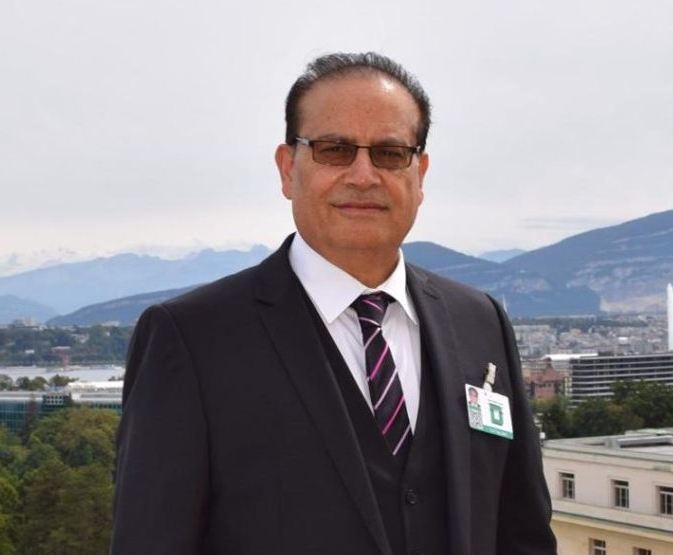
Qamar Bashir
The war now unfolding between Iran on one side and the United States and Israel on the other did not begin merely as a confrontation over nuclear enrichment or missile development. Those issues were presented to the world as the immediate justification, but the deeper strategic objective has long been understood by many analysts: regime change in Tehran. The assumption guiding years of sanctions, covert operations, cyber warfare, and now open military confrontation was that if Iran’s leadership could be decapitated, its missile and drone infrastructure destroyed, its naval capabilities crippled, and its economy suffocated, the Iranian people would eventually rise against their own government and replace it with a system aligned with Western and Israeli interests.
This strategy reflects a strategic vision that Israeli leaders, particularly Prime Minister Benjamin Netanyahu, have advocated for decades. Netanyahu repeatedly warned that Iran represented the greatest existential threat to Israel and argued that Tehran’s nuclear ambitions must be stopped before they matured. Yet critics of this argument note an important historical reality: when the earliest calls for confronting Iran began more than four decades ago, Tehran possessed neither a meaningful missile arsenal nor sophisticated drone capabilities. Its nuclear program remained limited and subject to international monitoring through the International Atomic Energy Agency. From that perspective, many observers believe that the nuclear narrative became a strategic instrument used to justify a broader geopolitical goal—the weakening or transformation of Iran as an independent regional power.
The operational plan appeared straightforward. Remove key leaders, destroy strategic military facilities, and allow internal unrest to complete the process of political change. Early phases of the conflict seemed to follow that script. Massive air strikes targeted military installations, command centers, missile launch sites, and naval bases. Thousands of targets were struck in rapid succession, creating the impression that Iran’s military capabilities were collapsing and that the regime might soon lose control.
The United States soon escalated the campaign further. President Donald J. Trump announced that American forces had carried out one of the most powerful bombing raids of the war on Iran’s Kharg Island, the country’s most critical oil export terminal. The president stated that U.S. aircraft had destroyed every military target on the island while deliberately avoiding the destruction of the oil infrastructure itself. Kharg Island is the lifeline of Iran’s petroleum exports, handling roughly ninety percent of the country’s crude shipments. Trump warned, however, that if Iran interfered with maritime traffic through the Strait of Hormuz, the United States could reconsider its restraint.
Yet the expected political collapse inside Iran has not materialized. Instead, the external attacks appear to have triggered a powerful instinct for national cohesion. Iranian society, shaped by centuries of resistance to foreign intervention, has not rallied behind calls for externally driven regime change. The assumption that military pressure would spark a popular uprising has proven to be one of the central miscalculations of the conflict.
At the same time, Iran has responded by widening the battlefield beyond its own territory. Rather than fighting only within its borders, Tehran has attempted to redistribute the economic burden of the war across the entire Middle East and ultimately the global economy. Missile and drone attacks, threats against regional energy infrastructure, and disruptions to maritime routes have created an atmosphere of strategic uncertainty that extends far beyond Iran itself.
The global energy system lies at the center of this confrontation. The Strait of Hormuz remains one of the most critical maritime corridors in the world. Military planners have increasingly warned that reopening the Strait of Hormuz by force would be far more complicated than it appears in theory. Even if the navies of the United States, the United Kingdom, and France attempted to escort commercial tankers through the strait, analysts believe it would be extremely difficult to guarantee safe passage without Iran’s consent. For this reason, many defense experts argue that reopening the corridor through purely military means would be risky and uncertain, and that stable navigation would likely require some form of diplomatic understanding with Iran.
The war has also exposed the vulnerability of even highly advanced military powers. Israel possesses one of the world’s most sophisticated intelligence networks and defense systems. Yet sustained missile and drone exchanges demonstrate that modern warfare imposes heavy economic and psychological costs on any society. Repeated missile alerts, damage to infrastructure, and disruptions to daily life illustrate the limitations of technological superiority when conflicts become prolonged.
Another important dimension of the conflict is the growing unease among Gulf Arab states hosting American military bases. Countries such as Qatar, Bahrain, and Kuwait have long relied on the U.S. security umbrella as a deterrent against regional instability. However, these bases now risk becoming direct targets in a wider confrontation. What was once viewed as protection increasingly appears to some regional leaders as a potential magnet for retaliation.
A notable geopolitical alignment has also emerged between Israel and India. Over the past two decades, India has become one of Israel’s closest defense partners, cooperating extensively in drone development, missile defense systems, surveillance technologies, and intelligence sharing. This partnership is not merely technological but also reflects a similar strategic worldview. Israel’s doctrine seeks to maintain overwhelming regional superiority so that no neighboring state can challenge its security. India’s concept of “Akhand Bharat,” or Greater India, imagines a restoration of influence across the broader South Asian subcontinent. While framed primarily in cultural terms, it reflects a desire to neutralize regional rivals and consolidate influence across neighboring territories. This parallel strategic outlook helps explain India’s diplomatic support for Israel during the current conflict.
Perhaps the most revealing aspect of the war is how dramatically the perception of victory has shifted since the first days of fighting. When hostilities began on February 28, many analysts predicted a rapid victory for the United States and Israel. Early strategic assessments informally estimated that Washington had roughly a 50–55 percent probability of determining the outcome, Israel around 30–35 percent, and Iran barely 10–15 percent. The reasoning was simple: overwhelming airpower, technological superiority, and intelligence dominance would quickly dismantle Iran’s military capacity.
After the war has entered into its third week, many strategic observers now estimate that the United States retains roughly 40–45 percent influence over the ultimate outcome, Israel about 25–30 percent, while Iran’s strategic position has risen to roughly 25–30 percent due to its ability to internationalize the consequences of the conflict. In essence, the war has evolved into two parallel contests: a tactical war dominated by American and Israeli military power, and a strategic war in which Iran attempts to raise the economic and geopolitical cost for its adversaries and the global system.
One of the greatest casualties of the conflict is the credibility of the international rules-based order as a result of a gradual shift toward a world governed less by international law and more by raw geopolitical power. Smaller states increasingly fear that they may become targets if they lack strong alliances or military capabilities. Arms races accelerate, mistrust deepens, and regional conflicts risk cascading into broader confrontations.
The Iran war therefore represents more than a regional crisis. It is a defining moment for the emerging global order. Whether diplomacy eventually prevails or escalation continues will shape not only the future of the Middle East but also the credibility of the institutions designed to preserve international stability.
For now, the battlefield remains active, the diplomatic channels remain fragile, and the outcome remains uncertain. What is clear, however, is that the war has already reshaped the geopolitical landscape—revealing the limits of military power, the resilience of national identity, and the profound risks of a world drifting away from international cooperation toward the harsher logic of power politics.
Qamar Bashir
Press Secretary to the President (Rtd)
Former Press Minister, Embassy of Pakistan to France
Former Press Attaché to Malaysia
Former MD, SRBC | Macomb, Michigan