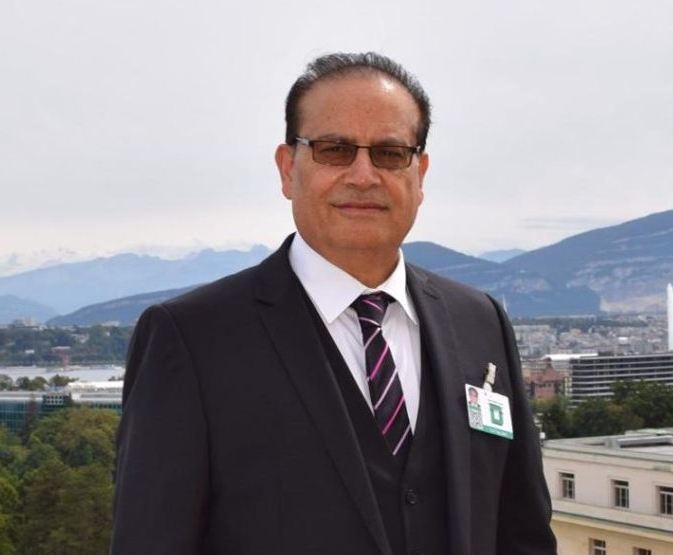
Qamar Bashir
The war between the United States–Israel alliance and Iran has entered a complex phase where battlefield destruction has not translated into political collapse. The campaign began with clearly articulated objectives: dismantle Iran’s nuclear capability, destroy its ballistic missile infrastructure, degrade its naval forces, and eliminate the networks through which Iran projects power across the Middle East. In the early stages of the conflict, large-scale aerial operations targeted missile depots, drone launch facilities, naval installations, command centers, and strategic infrastructure deep inside Iranian territory, including several high-value targets around Tehran.
Weeks into the war, however, the central political objective—the collapse or surrender of the Iranian regime—has not occurred. Iran’s military capacity has unquestionably been damaged. Missile sites, storage depots, air defense systems, and drone manufacturing facilities have been hit repeatedly. Thousands of targets have reportedly been struck, and casualties have included civilians, senior officials, and military commanders. Yet the Iranian state itself remains intact.
The leadership vacuum created by early strikes has been quickly filled. Replacement commanders have taken control of military units, administrative institutions continue to function, and the constitutional process for confirming or selecting national leadership is underway. This rapid institutional continuity reflects a fundamental design feature of the Iranian political system: it was built to withstand external shocks.
The result is a strategic paradox. Iran’s military infrastructure has been degraded, but its governing system survives. Wars aimed primarily at destroying weapons systems can achieve impressive tactical results while failing to achieve strategic victory if the political structure directing those weapons remains functional.
Iran’s history over the past four decades illustrates this resilience. The country has endured sanctions, economic isolation, technological restrictions, and sustained geopolitical pressure. During that period, Iran invested heavily in domestic industrial capabilities, scientific research, and decentralized defense production. The destruction of physical facilities therefore does not eliminate the technical knowledge, engineering expertise, or human capital that produced them. As long as these capabilities remain embedded within the state’s institutions, rebuilding remains possible.
The Islamic Revolutionary Guard Corps continues to function as the backbone of Iran’s defense system. With hundreds of thousands of personnel and extensive logistical networks, it represents both a military force and a political institution deeply integrated into the country’s governance. Even if several of its facilities have been damaged, the organization itself remains intact and committed to defending the state.
Because of this resilience, the center of gravity in the war is gradually shifting away from purely military objectives toward economic pressure—particularly control over global energy routes.
The Strait of Hormuz has become the most critical strategic flashpoint. This narrow waterway connects the Persian Gulf to global markets and carries a substantial share of the world’s oil supply. Under normal circumstances, millions of barrels of crude oil move through the strait every day, fueling industries, transportation systems, and national economies across multiple continents. Disruption in this corridor sends immediate shockwaves through global markets.
Oil is the lifeblood of modern economies. Transportation networks, manufacturing industries, agricultural systems, and global logistics chains all depend on stable energy supplies. When oil flow is threatened, the consequences extend far beyond the battlefield.
The current conflict has already produced visible economic effects. Oil prices have risen significantly across international markets, and the impact is being felt across the United States, Europe, the Middle East, Africa, and Asia. Higher energy prices are increasing transportation costs, raising manufacturing expenses, and placing upward pressure on inflation.
Even countries that produce their own oil cannot fully escape these effects. Modern economies are deeply interconnected. Rising shipping costs, higher insurance premiums for maritime transport, and disruptions in global supply chains raise the cost of goods and services almost everywhere.
As fuel prices rise, the cost of living rises with them. Transportation becomes more expensive. Food prices increase because agriculture depends heavily on fuel for machinery and distribution. Industrial production costs rise. Consumers experience declining purchasing power.
This economic pressure may ultimately become the most powerful force influencing the war’s outcome. Democratic societies are especially sensitive to such economic shocks. In the United States and across Europe, populations are politically active and economically demanding. When citizens begin to experience sustained increases in living costs—whether through gasoline prices, heating bills, or inflation in essential goods—they inevitably question the policies responsible for those conditions.
Public debate intensifies. Legislatures face scrutiny. Opposition movements gain momentum. Citizens begin asking whether the objectives of a war justify the economic hardship imposed upon them.
If energy prices continue rising for a prolonged period, domestic pressure within Western societies could grow rapidly. Protest movements, political opposition, and electoral pressures may begin pushing governments toward negotiation or de-escalation.
Energy-importing nations across Asia, Africa, and Latin America may also demand stability in global markets. Many developing economies are extremely vulnerable to energy price spikes. Rising fuel costs strain national budgets, accelerate inflation, and threaten economic stability. These countries may therefore use diplomatic channels to push for an end to hostilities.
Interestingly, Iran itself may be relatively better positioned to endure prolonged energy disruptions. As a major oil producer with experience surviving decades of sanctions, the country has developed economic coping mechanisms that wealthier societies rarely face. This does not mean Iran is immune to economic pain, but its population has historically endured hardship more frequently than populations in highly industrialized economies. In a prolonged conflict, this difference in economic tolerance may influence political dynamics.
Another critical dimension of this war is unfolding beyond the immediate battlefield. Major global powers such as China and Russia are watching the conflict extremely closely. While not directly involved in the fighting, both countries are observing every stage of the conflict with strategic interest.
Modern wars serve not only as military confrontations but also as real-time laboratories of technological and strategic knowledge. China and Russia are likely analyzing every aspect of the conflict: the deployment of U.S. naval forces, the logistics of long-distance power projection, the performance of advanced missile defenses, the effectiveness of cyber warfare techniques, and the coordination between allied military forces. They are also observing the economic tools used in the conflict—sanctions, financial restrictions, and trade disruptions.
By studying these dynamics, both countries can refine their own strategic planning. Every weapon system used in the war provides valuable data. Every military maneuver reveals operational strengths and weaknesses. Every cyberattack or defensive response demonstrates new capabilities.
In effect, the war provides China and Russia with a rare opportunity to observe the full spectrum of American and allied military power in real-world conditions. This information can then be incorporated into their own military development programs. Lessons drawn from the conflict may influence the design of future missile systems, air defense networks, naval strategies, and cyber warfare capabilities. In the long term, this means the conflict could unintentionally accelerate the military modernization of America’s strategic competitors.
By revealing operational methods, logistical patterns, and technological performance under battlefield conditions, the war offers insights that might otherwise take decades to obtain. From this perspective, the geopolitical consequences of the conflict extend far beyond the Middle East.
The war is simultaneously reshaping energy markets, testing political resilience within democratic societies, and providing valuable strategic intelligence to rival global powers.
These multiple pressures may ultimately shape the war’s conclusion.
Military power alone rarely determines the final outcome of conflicts involving resilient states. Economic pressure, political legitimacy, and international strategic calculations often play equally decisive roles. Iran has absorbed significant military damage but remains politically intact. The United States and Israel possess overwhelming military capability but face increasing economic and geopolitical complications as the conflict continues.
Meanwhile, global powers observing from the sidelines are quietly gathering knowledge that could reshape future strategic balances. In the end, the decisive factor may not be the destruction of missiles or military bases. The outcome may instead be determined by the economic strain of rising energy prices, the political pressure of public opinion, and the strategic calculations of global powers watching closely from afar.
The war’s endgame therefore remains uncertain. What began as a campaign to destroy military capabilities may ultimately evolve into a broader contest involving economics, diplomacy, and the shifting balance of global power.
Qamar Bashir
Press Secretary to the President (Rtd)
Former Press Minister, Embassy of Pakistan to France
Former Press Attaché to Malaysia
Former MD, SRBC | Macomb, Michigan