
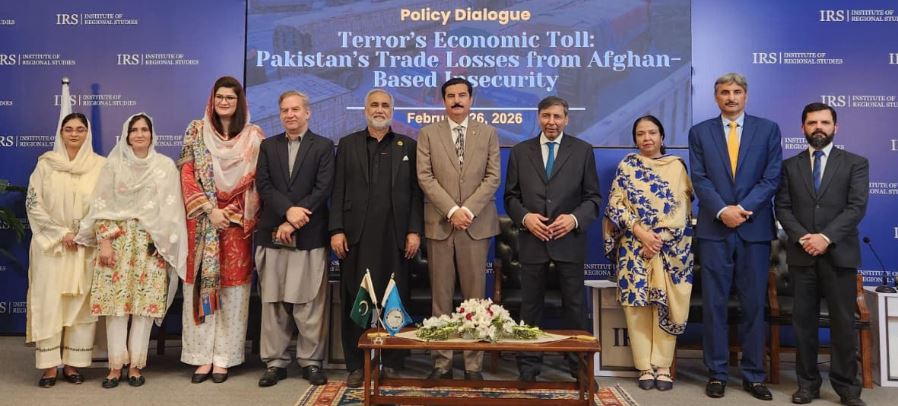
ISLAMABAD, MAR 4 /DNA/ – Speakers at a policy dialogue hosted by the Institute of Regional Studies (IRS) warned that Afghan-based insecurity and recurring border closures are inflicting multi-billion-dollar losses on Pakistan’s trade, transit potential and regional connectivity plans. The dialogue—“Terror’s Economic Toll: Pakistan’s Trade Losses from Afghan-Based Insecurity”—was held at IRS, Islamabad, on February 26, 2026.
IRS President Ambassador Jauhar Saleem said Pakistan’s geographic advantage as a bridge between South and Central Asia can deliver growth only if border operations remain predictable and reliable. He noted that repeated disruptions at Torkham and Chaman have strained supply chains, eroded investor confidence, and risk diverting traders to alternative long-term routes.
Governor Khyber Pakhtunkhwa Faisal Karim Kundi, the chief guest, stressed that “a secure border must also be a functional border,” calling for stronger federal–provincial coordination, infrastructure readiness and policies that turn frontier pressures into economic opportunity.
In the keynote, Maria Kazi (Joint Secretary, Ministry of Commerce) reported corridor trade fell from USD 7.5 billion (2022–23) to USD 4 billion (2024–25) amid closures. She said escalations on October 11–12, 2025 led to extended shutdowns at multiple crossings, leaving 7,000+ transit containers stranded and undermining USD 500 million in terminal investments. Losses were estimated at ~USD 3 billion annually for Pakistan and over USD 6 billion for the region, with transport cost and time rising 2.5 times.
Panelists urged restoring border predictability, protecting livelihoods, and aligning security measures with trade facilitation.













 warned that Afghan-based insecurity)