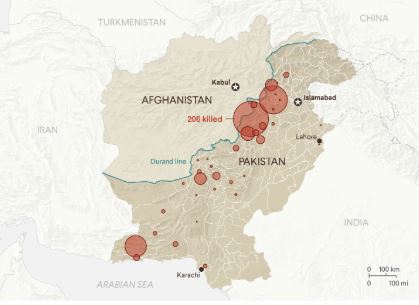
In a dramatic escalation of long-simmering tensions, Afghan forces launched unprovoked attacks along the Pakistan-Afghanistan border on February 26, triggering fierce retaliatory strikes from Pakistani security forces. The clashes, centered in Khyber Pakhtunkhwa’s Chitral, Khyber, Mohmand, Kurram, and Bajaur sectors, have resulted in significant casualties on both sides, exacerbating an already volatile regional security landscape. Pakistani officials claim their forces inflicted heavy losses, killing 133 Afghan Taliban soldiers and wounding over 200, while destroying multiple border posts and military equipment.
Conversely, the Taliban government in Kabul asserts it captured several Pakistani outposts, killed 55 Pakistani soldiers, and took some troops alive, denying substantial losses on their side.
Independent verification remains elusive amid the fog of war, but reports confirm at least two Pakistani soldiers killed and three injured, alongside civilian casualties, including injuries in Afghan refugee camps.
This latest flare-up follows Pakistan’s intelligence-based airstrikes on February 22, targeting Tehreek-e-Taliban Pakistan (TTP) hideouts in Afghanistan’s Nangarhar, Paktika, and Khost provinces, which Pakistan says eliminated over 80 militants.
Afghanistan condemned those strikes as violations of its sovereignty, claiming civilian deaths, including women and children. In response, Afghan forces initiated cross-border firing, prompting Pakistan to launch Operation Ghazab lil-Haq, including airstrikes on Kabul, Kandahar, and Paktia.
Pakistan’s Defense Minister Khawaja Asif declared it an “open war,” signaling a dangerous shift from sporadic skirmishes to sustained conflict. All said and done, this development bodes ill for the region. Pakistan and Afghanistan, bound by geography, history, and shared ethnic ties across the porous 2,600-kilometer Durand Line, must coexist as neighbors. The human cost is staggering: families displaced, economies disrupted, and trust eroded. Retrospection is imperative. Both sides must learn from past mistakes—Pakistan’s historical support for the Taliban during the 1990s, which backfired with the rise of anti-Pakistan militants, and Afghanistan’s failure to curb cross-border terrorism post-2021 Taliban takeover.
The TTP, often labeled “Fitna al-Khawarij” by Pakistani officials, has exploited Afghan soil for attacks inside Pakistan, including recent suicide bombings.
Meanwhile, Kabul’s grievances over border fencing and airstrikes echo decades of unresolved territorial disputes. Without mutual accountability, these cycles of violence will persist, fueling instability in South Asia. External powers exacerbate the rift, adhering to a classic divide-and-rule strategy. Certain global actors—implicitly the United States and others with interests in Central Asia—benefit from prolonged discord, preventing a unified Pakistan-Afghanistan bloc that could stabilize trade routes and counterbalance influences in the region. More pointedly, India is accused of playing a pivotal role in supporting the Taliban government, allegedly as a proxy to destabilize Pakistan.
Pakistan’s leadership, including Asif, has claimed Afghanistan has become an “Indian colony,” with New Delhi providing diplomatic, economic, and possibly covert aid to the Taliban to counter Islamabad.
This shift is evident in India’s reopening of its Kabul embassy in 2022, high-level visits like Afghan Foreign Minister Amir Khan Muttaqi’s trip to New Delhi in October 2025, and statements condemning Pakistani strikes while affirming Afghan sovereignty. Allegations persist that India supports TTP elements through Afghan channels, intensifying Pakistan’s security woes.
Such maneuvers align with India’s strategy to encircle Pakistan, leveraging historical animosities from the Afghan civil wars where New Delhi backed anti-Taliban forces.
Pakistan now faces a two-front dilemma: the eastern border with India, marked by ongoing Kashmir tensions, and the western front with Afghanistan. Sustaining defenses on both requires immense resources, straining an economy already grappling with inflation and debt. Yet, victory abroad hinges on peace at home. Internal political harmony is crucial; without it, Pakistan risks fragmentation. Stakeholders must align, convincing all political parties—including the genuine leadership of Pakistan Tehreek-e-Insaf (PTI)—to prioritize national security over partisan divides. PTI’s Imran Khan, despite legal hurdles, represents a significant voice; engaging him and his supporters could bridge gaps.
A national all-parties conference (APC) is essential to forge cohesion. Such a moot would allow dialogue on border policies, counter-terrorism, and diplomacy, rallying the nation against external threats. Minister of State for Interior Talal Chaudhry’s vow that “no one will be allowed to take away Pakistan’s peace” resonates, but it demands unity.
Drawing from past conflicts, like the May 2025 India-Pakistan skirmishes, Pakistan has shown resilience when cohesive. Emphasizing diplomacy with Kabul, perhaps through third-party mediation, while bolstering internal stability, could de-escalate tensions.
In conclusion, this border crisis underscores the fragility of South Asian peace. Pakistan and Afghanistan must transcend blame, embracing lessons from history to build trust. External meddling, particularly India’s alleged support for the Taliban, only perpetuates suffering. For Pakistan, the path forward lies in domestic solidarity—only then can it effectively navigate these dual fronts and secure a prosperous future for the region.