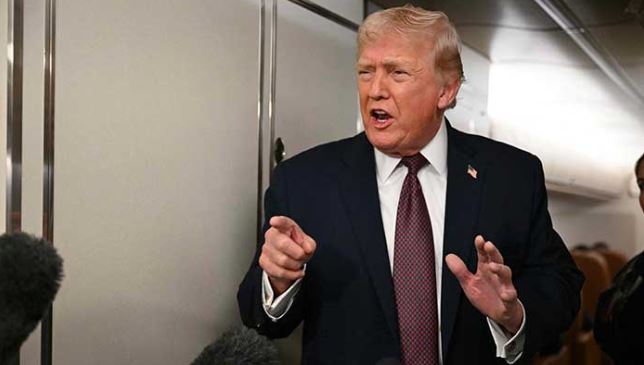
DAVOS, JAN 23: US President Donald Trump stole the show at the World Economic Forum in Davos, but he may have also made the annual gabfest of the global elite relevant again — at least for a week.
The relevance of the gathering of CEOs and political leaders in the Swiss Alps is regularly questioned by critics who deride it as an out-of-touch echo chamber where little gets done.
But all eyes were on this year’s Davos as Trump barrelled into town with a geopolitical storm hanging over the picturesque ski resort, where he pressed his case to acquire Greenland.
Hundreds of people stood in huge lines to hear Trump deliver a speech that drew gasps and nervous laughs as he mocked allies but also praised the “brilliant” A-listers in the room — and ultimately ruled out using force to take Greenland.
“It’s interesting that people were lining up to hear President Trump like they were not lining to hear any other speaker. None has got such kind of interest,” Latvian President Edgars Rinkevics told AFP.
“I think that to some extent, Davos is back to what it was meant to be. To hear different perspectives, to argue, to discuss, to disagree sometimes, to agree, to somehow build bridges rather than to destroy them,” he said.
Davos became the scene of intense diplomacy, culminating with Trump announcing a “framework of a future deal” on Greenland following talks with NATO Secretary-General Mark Rutte.
A day later, Trump met Ukrainian President Volodymyr Zelensky as part of his effort to end Russia’s war in Ukraine, while also launching his “Board of Peace”.
There was even a rare standing ovation this year — for Canadian Prime Minister Mark Carney, who described a “rupture” in the global order in a speech that angered Trump.
– ‘Failed policy’ –
It had been years since the WEF, founded in 1971, had been at the epicentre of such a momentous political episode.
The forum’s previous landmark moments include hosting a thaw in Greek-Turkish tensions in 1988, and talks between Nelson Mandela and South Africa’s apartheid-era president F. W. de Klerk in 1992.
Yet the renewed attention on Davos was not just about diplomacy and deal-making. It was also about confrontation.
The Trump administration descended on the Swiss resort in force to push its America First agenda — the antithesis of the WEF’s pro-globalisation creed.
“We are here to make a very clear point: globalisation has failed the West and the United States of America,” US Commerce Secretary Howard Lutnick said during a panel discussion.
“It’s a failed policy. It is what the WEF has stood for,” Lutnick said.
This year’s meeting also comes at a turning point for the WEF after its founder, Klaus Schwab, stepped down as head of the forum amid allegations of wrongdoing, for which he was later cleared after an internal investigation.
The head of US investment giant BlackRock, Larry Fink, took over as interim co-chair and acknowledged in his opening remarks to the forum the criticism that the WEF has faced.
“It’s also obvious that the world now places far less trust in us to help shape what comes next. If the World Economic Forum is going to be useful, going forward, it has to regain that trust,” Fink said.
The billionaire floated the idea of hosting WEF meetings in “places where the modern world is actually being built”, such as Detroit or Dublin.
– ‘The people who matter are here’ –
But the WEF is still a place where the rich and powerful come to network and do business first.
Marc Benioff, the CEO of tech firm Salesforce, was in his element as he shook hands with other corporate titans in the corridors of the congress centre.
“I think for CEOs, still, the fundamental operation of their business, the implementation of AI, the transformation into this new world, that’s number one,” Benioff told AFP after chatting with PepsiCo boss Ramon Laguarta.
“Obviously, there’s a geopolitical situation going on, but I think for the vast majority of attendees, it’s not impacting them,” he said.
Benioff was among an A-list of CEOs that included Apple’s Tim Cook and Nvidia’s Jensen Huang, invited to meet Trump in Davos.
“The people who matter are here and the conversations that are important are happening here,” Benioff said.