
by Muhammad Mohsin Iqbal
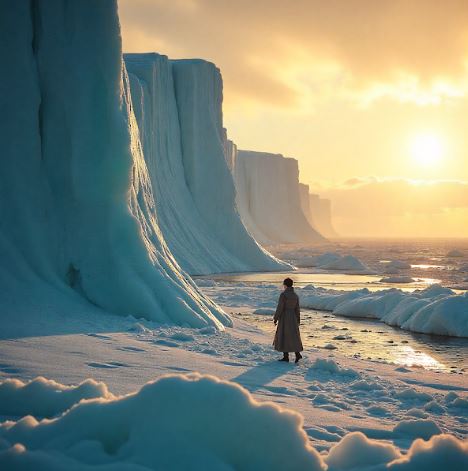
Greenland, for centuries perceived as a silent expanse of ice at the edge of the known world, has emerged as one of the most consequential pieces on the contemporary geopolitical chessboard. What was once regarded as inhospitable and peripheral is now viewed as pivotal, even decisive, in shaping future balances of power. The renewed American fixation on Greenland, particularly under President Donald Trump’s return to office, is rooted not in impulse but in a sober assessment of geography, resources, and the profound transformations unfolding in the Arctic.
Trump’s earlier proposal in 2019 to purchase Greenland was initially dismissed as eccentric. Yet with the accelerating effects of climate change and intensifying great-power rivalry, the logic behind that idea has gained strategic coherence. The current discourse is less about literal annexation and more about leverage, influence, and long-term control. Diplomatic overtures, economic incentives, and deliberately provocative rhetoric have all been employed to signal that Washington considers Greenland essential to its national security calculus. The language of choice—suggesting an “easy way or a hard way”—is designed less to announce imminent action than to apply pressure and redefine negotiating boundaries.
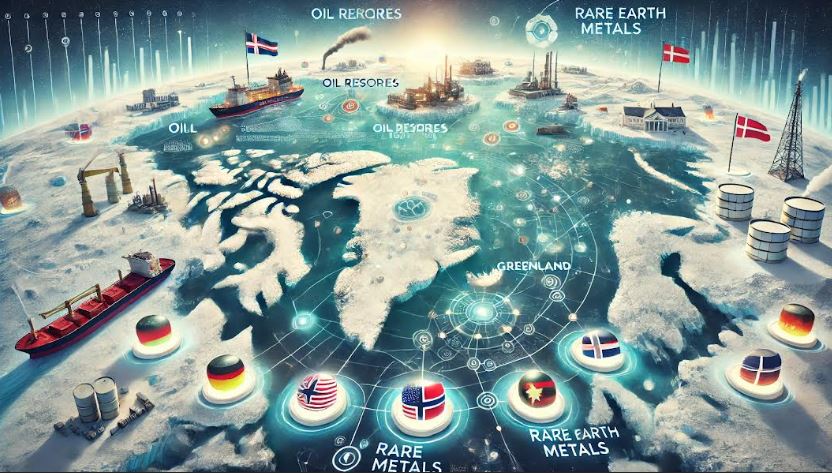
At the core of this interest lies the Arctic’s transformation from a frozen backwater into a navigable and contested space. Melting ice is opening sea routes that dramatically shorten distances between Asia, Europe, and North America. Voyages that once took forty days via the Suez Canal may soon be completed in little more than twenty through Arctic passages. Greenland occupies a commanding position at the Atlantic entrance of these emerging routes, particularly near the Northwest Passage and the future transpolar corridor. Influence over Greenland would grant the United States a vantage point from which to monitor, secure, and potentially shape the rules governing these new arteries of global trade and military movement.
Equally compelling is what lies beneath Greenland’s ice. The island is believed to possess significant deposits of rare earth elements, indispensable for advanced electronics, renewable energy technologies, and modern defence systems. In an era where China’s dominance over rare earth supply chains has become a strategic vulnerability for the West, Greenland offers the prospect of diversification and autonomy. Added to this are potential reserves of oil, gas, and other minerals, whose exploitation becomes more feasible as ice retreats. For an administration intent on economic self-reliance and industrial strength, Greenland appears not merely as territory, but as strategic insurance.
Yet Greenland’s allure is not purely material. There is a symbolic dimension that resonates deeply with Trump’s political ethos. Territorial expansion, bold deal-making, and visible assertions of power align neatly with an “America First” narrative that prizes dominance and psychological advantage. In this framing, Greenland becomes a statement as much as a strategy—a demonstration that the United States intends to shape the future rather than react to it.
This ambition, however, collides with political, legal, and moral constraints. Greenland is an autonomous land whose people have repeatedly and unequivocally rejected the idea of becoming Americans. Their attachment to self-rule, cultural identity, and gradual movement toward greater independence from Denmark is profound. Denmark itself, as a sovereign state and a founding member of NATO, has made clear that any attempt at coercion would be unacceptable. Such a move would not merely strain alliances; it could shatter them, calling into question the very foundations of the post–Second World War order built on respect for sovereignty.
The repercussions of any forced acquisition would be far-reaching. NATO unity could fracture, European allies might impose diplomatic and economic penalties, and international institutions would likely condemn the act as illegal. The anticipated economic benefits of resource access could quickly be outweighed by the costs of military deployment, legal disputes, market volatility, and the long-term obligation to subsidise infrastructure and services for a small, remote population. Within the United States, such an action would provoke intense domestic division, with supporters hailing strategic boldness and critics warning of imperial overreach and constitutional crisis.
Rival powers would almost certainly respond. Russia, which has heavily militarised its Arctic frontier and views the region as central to its future, would regard expanded U.S. influence in Greenland as a direct challenge. Increased patrols, strategic signalling, cyber activity, and closer coordination with China could follow, accelerating an Arctic arms race. What is framed as a move for security could thus generate new insecurities, heightening the risk of miscalculation in a fragile environment.
Environmental and humanitarian concerns further complicate the picture. Accelerated resource extraction could worsen ecological damage, intensify ice melt, and threaten Arctic biodiversity. Greenland’s indigenous communities might face displacement or erosion of rights, transforming a strategic project into a moral dilemma with global repercussions.
Ultimately, the secrets Greenland may reveal extend beyond minerals, shipping lanes, or military bases. They speak to the nature of power in an era defined by interdependence, climate change, and contested norms. Greenland stands at the intersection of ambition and restraint, opportunity and risk. In seeking to unlock its strategic value, the world may discover that the greatest revelation lies not in Greenland itself, but in how nations choose to pursue power in a rapidly changing world.