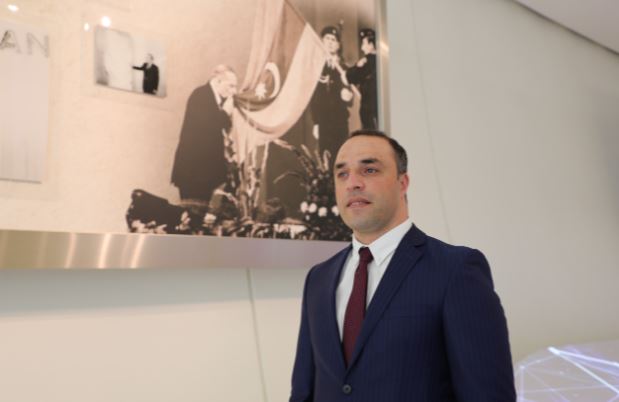
Fərid Mustafayev
One of the gravest trials endured by the Azerbaijani people in the twentieth century is associated with the events of the night of January 20. That night was not only remembered for the deployment of military equipment against unarmed civilians.
It entered history as a moment when the patience, will, and historical memory of an entire nation were deliberately targeted. The scale of the events, the nature of the violence employed, and the subsequent information manipulations demonstrated that the objective was not merely physical control, but also the creation of deep moral and psychological shock. Against the backdrop of these complex and contradictory processes, Heydar Aliyev’s position acquired particular significance.
He assessed the events not only in terms of their immediate course, but within a framework of cause-and-effect relationships. For Heydar Aliyev, January 20 was not confined to a single night. It represented the culmination of long-accumulated political contradictions, legal voids, and disregard for national will.
He categorically stated that armed intervention could under no circumstances be presented as a means of ensuring public order, because the concept of public order is founded upon law, security, and human dignity. On the night of January 20, all of these principles were trampled. Heydar Aliyev’s stance was formed precisely on this basis, and he substantiated it both politically and legally. The immediate analytical approach to the events was a clear reflection of Heydar Aliyev’s political mindset.
He did not limit himself to emotional reactions. On the contrary, he emphasized the necessity of a systematic evaluation of what had occurred. For him, the primary issue was not merely naming those responsible, but correctly identifying the essence of the events themselves. Without an accurate diagnosis, no sound conclusion could be reached. In his position addressed to the Soviet political leadership, Heydar Aliyev placed the concept of responsibility at the center. He believed that evading responsibility only aggravated the situation and further eroded trust between society and authority.
Therefore, he demanded that the events receive an objective legal and political assessment. For that period, this demand was not only courageous, but also deeply principled. The impact of the tragedy on individual human lives did not escape Heydar Aliyev’s attention. In his view, those who perished were not statistical figures. Each loss represented a family tragedy, the pain of a generation, and a profound shock to society.
From this perspective, he approached the events not solely through a political lens, but with humane and ethical considerations. This approach played a significant role in society’s acceptance of him as a moral leader. His attention to the families of the victims was a tangible expression of social responsibility. He openly declared that the state is not merely a structure of power institutions; above all, it must be capable of sharing in the suffering of its citizens. This position had a serious influence on shaping the public mood in the aftermath of January 20. In his addresses to the domestic audience, the primary objective was to prevent the deepening of panic and chaos within society.
Heydar Aliyev emphasized a reasoned stance, patience, and the idea of national unity. He understood that emotional fragmentation could lead to long-term consequences. For this reason, he presented national solidarity as a strategic necessity. His appeals to the international community, on the other hand, were aimed at ensuring global recognition of the events. Heydar Aliyev understood that an information vacuum could result in the loss of truth. Therefore, he considered it essential that the realities of January 20 be voiced on the international stage. This was an important step both in terms of political responsibility and the preservation of historical memory. A key element in his speeches was the strengthening of national self-awareness.
For Heydar Aliyev, January 20 was not merely the pain of the past; it was a serious message regarding how the future should be constructed. He believed that the people must draw conclusions from this tragedy and enter a stage of political maturity.
He associated January 20 with the concept of national responsibility. In his view, freedom is not only an aspiration, but also a responsibility—a responsibility borne by both political leaders and society as a whole. This perspective enabled the events to be perceived not merely as an emotional memory, but as a strategic lesson.
His analytical stance played a significant role in the transformation of public consciousness. Heydar Aliyev demonstrated that it is not enough to approach history solely through mourning; history must shape thought. It was precisely this approach that accelerated the understanding of the January 20 events within the context of national identity.
Over time, the historical significance of Heydar Aliyev’s position became increasingly evident. The assessment of the events did not change, but society’s perception of that assessment deepened. His principles evolved into a model of political conduct and, in later periods, became one of the foundational pillars of statehood thinking.
The events of January 20 revealed the unbreakable will of the Azerbaijani people, while Heydar Aliyev’s response to these events became the political expression of that will. His stance proved that national memory can be further strengthened through a leader’s position.Today, when we look back at the January 20 events, it becomes clear that Heydar Aliyev’s position was not merely a historical fact, but also a moral compass. His stance ensured that the events were not forgotten over time, that their essence was not distorted, and that they continued to live on in national memory in an accurate and dignified manner.
Thus, the January 20 tragedy remains in the history of Azerbaijan as both a period of pain and a moment of awakening. Heydar Aliyev’s assessment of this tragedy became one of the key factors defining its political and moral framework. This position played an important guiding role in the historical path of the nation and continues to retain its relevance today.
Fərid Mustafayev
Deputy Chairman of the “Progress” Social and Economic Research Public Union,
Member and activist of the New Azerbaijan Party Yasamal District Organization